
40+ Cloud Storage Statistics in 2026

Each year, there are increasing risks to the security of cloud data and our online privacy. Cloud storage statistics help us understand these risks in the cloud, how to prevent them, and which is the best cloud storage you can choose to protect your data.
Throughout this article, we will cover:
- Cloud security statistics
- Data privacy statistics
- Online privacy statistics
- Internet privacy statistics
- How to protect your security and privacy online
By understanding the common security risks in the cloud, we can also learn how to prevent them with cloud storage services and online privacy tools.
Table of contents
- Cloud security statistics
- Data privacy statistics
- Online privacy statistics
- Internet privacy statistics
- How to ensure the best cloud security
- Best cloud storage to protect your data
- Related tools
Cloud security statistics
Below are cloud security statistics from 2026, covering data stored in the cloud, how organizations store data, and the common threats to cloud environments.
- 88% of organizations operate in hybrid or multi-cloud environments.
- 66% of organizations are not confident in their ability to detect and respond to cloud threats in real time
- 70% cite misconfigured cloud services as a major cloud security risk.
- 66% cite data exposure as a major cloud security risk.
- 81% of organizations rely on two or more cloud providers for critical workloads.
- More than 200 cyber incidents affected the UK's critical national infrastructure in the past year, and roughly 75% were linked to state actors.
- Around 100 zettabytes of data are expected to be stored in the cloud by 2026.
- Cloud storage accounts for 80% of all data storage worldwide.
- Zero‑trust architectures (never trust, always verify) are being widely adopted to secure cloud workloads, replacing traditional perimeter‑based models.
- Compromised identities account for over 70% of cloud breaches, and this trend will accelerate as attackers exploit AI to automate credential harvesting and privilege escalation attacks.
Importance of cloud security statistics
As data stored in the cloud continues to grow, enterprises and businesses face the challenge of how to store this data and the best way to protect it.
One of the most effective methods for cloud storage or hybrid cloud storage models is a zero-trust model.

This security model is based on a “never trust, always verify” philosophy. So unlike traditional security protocols that automatically trust users and devices, a zero-trust model will always require security verification, regardless of the device and previous access.
Data breach cloud security statistics
Data breaches are a major threat to all companies. If data is leaked, it costs companies millions in compliance fines and puts customer data at risk of phishing, spam, and personal information leaking online or via the dark web.
Below are cloud security statistics regarding data breaches and common threats to cloud data.
- Ransomware attacks hit 78% of companies over the past year, with projected growth of 40% by the end of 2026 based on disclosed incidents. Attackers now target cloud backups directly,
- The average cost of a data breach globally stands at $4.44 million, while US organizations face $10.22 million average costs driven by regulatory fines and detection expenses.
- Breaches spanning multiple cloud environments take an average of 276 days to identify and contain, with healthcare incidents taking an average of 279 days.
- Human error drives 88% of all data breaches, with phishing as the most prevalent cloud breach vector affecting 73% of organizations.
- 45% of all data breaches now occur in cloud environments (public, private, or hybrid).
- 39% of cloud incidents directly expose sensitive data such as PII, financial records, or intellectual property.
- Over 70% of cloud breaches originate from compromised identities, establishing identity compromise as the dominant breach vector. Stolen credentials, session hijacking, and credential stuffing attacks
- Insider threats represent the costliest breach category, averaging $4.92 million, while phishing-related breaches average $4.8 million. Both attack types exploit human vulnerabilities and continue to affect organizations regardless of technical investment.
Data breach protection methods
From the above statistics, we can see that ransomware combined with phishing often appears in cloud security statistics as the main threat to companies, employees, and personal data.
For protection against ransomware, one of the most effective ways is cloud storage backups, which allow you to restore backed-up versions of files, plus the following cloud security benefits:
- File versioning: You can roll back to earlier, uninfected file versions.
- Immutability/object lock: Backups are made read-only for a set period and can’t be modified, so ransomware can't delete or encrypt them.
- Isolation from endpoints: Cloud backups are separated from your local network, so malware on your devices can't directly reach them.
- Rapid recovery: Data can be restored quickly without having to pay cybercriminals the ransom, reducing downtime and saving the business money.
For phishing protection, businesses should carry out regular employee training on how to identify phishing attacks, as well as AI scams, which are becoming more common and more advanced.
For security tools, phishing can be prevented with
- Encrypted email with advanced spam and phishing filters
- Enforce MFA for additional account protection
- Identity and access controls to prevent unnecessary access to sensitive data
Cloud security challenges statistics
Cloud security has quickly become one of the most critical areas of modern cybersecurity as organizations continue shifting workloads, applications, and data into cloud environments.
While cloud storage is considered a secure and controlled alternative to on-premises infrastructure, it is now the primary target for attackers, with cloud-related breaches officially surpassing traditional data center incidents, as shown by the statistics below.
- Cloud security breaches have officially surpassed on-premises data breaches.
- Malicious actors tend to target user IDs, customer phone numbers, comments, and private information.
- Cloud security statistics reveal that 25% of the world’s total cyber attacks are cloud security attacks.
- Cloud infrastructure attacks are climbing 21% year-over-year. Identity breaches are at the top, and misconfigurations are found in nearly 38% of breaches. APIs are the backbone of cloud apps and link to 31% of cloud data breaches.
- 63% of organizations report that storage and data-management costs force them to protect less data than they believe they should.
- 77% identify identity and access management (IAM) complexity as the top cloud-native security challenge.
As we can see, Identity and access management (IAM) is critical because most cloud breaches start with compromised credentials or misused access. Strong IAM reduces this risk by ensuring only the right people and systems can access the right resources, limiting damage even if an account is compromised.
Data privacy statistics
Related to cloud security, data privacy statistics from 2026 highlight how the switch to online privacy is becoming more common and important for people’s online lives.
- 85% of global consumers say they want more control over how their personal data is used.
- 72% of people are more concerned about data privacy now than they were two years ago.
- 63% of consumers have stopped using a service due to concerns about how their personal data is handled.
- 73% of consumers are more likely to trust companies that clearly explain how their data is used.
- 67% of users actively adjust privacy settings on platforms when given the option.
- 89% of European consumers are concerned about online privacy.
If you’re looking to switch from Big Tech companies to private alternatives, Internxt offers everything you need to stay protected online.
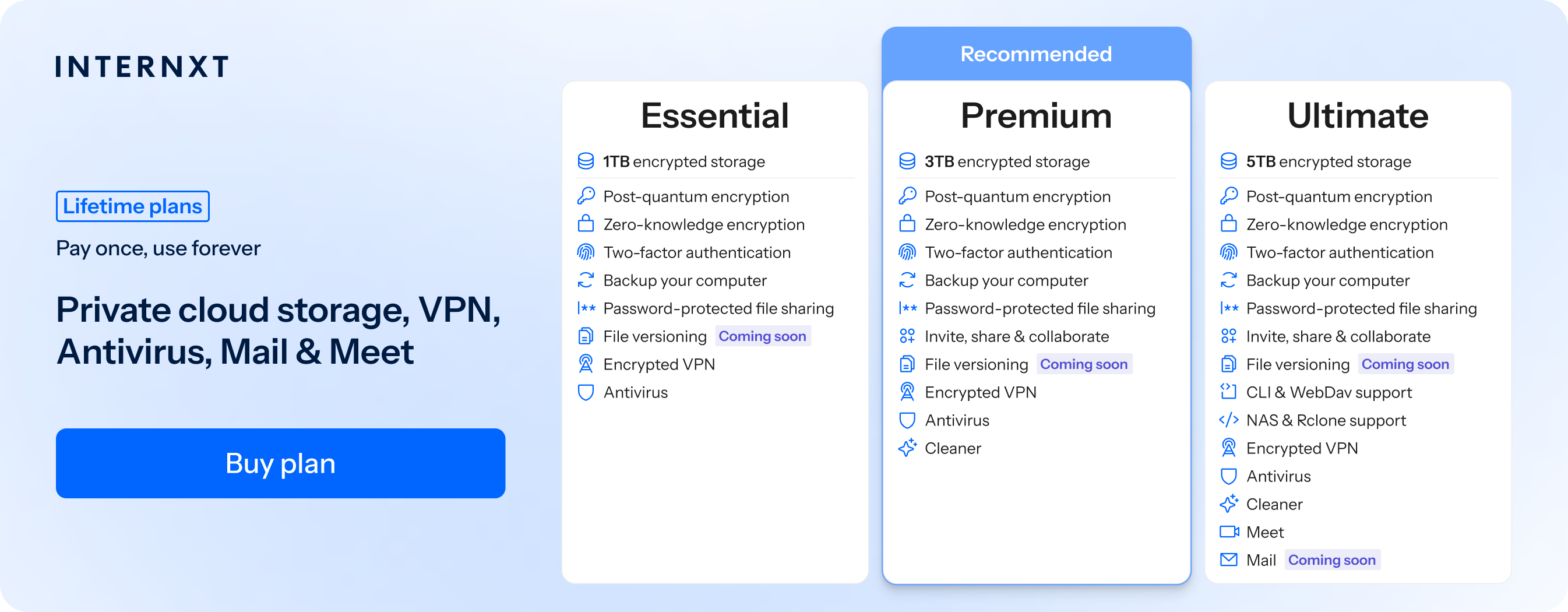
Plans include secure cloud storage, protected with post-quantum and zero-knowledge encryption, backups, VPN, Antivirus, Meet, Mail, and more.
Unlike other companies, Internxt’s mission is built on privacy. Internxt can’t see files you store or share in the cloud, and never uses your data for profit.
Online privacy statistics
As more companies face threats to data, more people are becoming concerned about their online privacy and how to protect it, as demonstrated by these online privacy statistics.
- 90% of consumers say protecting personal data is important, but only 55% feel confident doing it effectively.
- 57% of users believe their personal data has already been compromised at least once.
- 86% of consumers report increasing concern about how their data is being used online.
- 63% of users feel their data is less secure than it was five years ago.
- Only 37.6% of users actually read privacy policies before sharing personal data.
- 39% of users actively check whether websites are secure before submitting data.
Internet privacy statistics
When browsing the internet, we may feel like we are browsing in privacy, but the following internet privacy statistics show otherwise.
- Over 75% of tracking activity occurs before users even interact with cookie consent banners.
- More than 55% of websites continue tracking users even after explicit opt-out requests.
- 87% of large advertising platforms continue tracking users even when opt-out signals are enabled (in audit tests).
- Browser fingerprinting can uniquely identify users with high accuracy even without cookies.
- Modern tracking methods allow user re-identification across sites even in private/incognito mode.
- 31% of global internet users use a VPN at least monthly.
- Only 40% of users feel fully protected online, even when using privacy tools like VPNs.
- Internet Service Providers (ISPs) can still log browsing activity even when users are in incognito mode.
- Websites often increase tracking activity after users reject cookies instead of reducing it.
- Accepting cookie banners can increase the number of trackers on a page by up to 70 additional tracking scripts.
- Only 29% of users correctly understand that VPNs do NOT provide full anonymity online.
As we can see, we may think our privacy is protected online, but there are still ways our browsers can track our data.
To prevent this, we recommend downloading a secure and private browser, combined with Internxt VPN, to hide your IP address and secure your internet connection.

How to ensure the best cloud security
Encryption
Data encryption is the best and only way to ensure data is protected online in the cloud or local storage.
With encryption, even if a hacker accesses a system, the only thing they will see is scrambled text, protecting personal and confidential information.
Encryption is the standard for all forms of communication online, from messaging, cloud storage, and email.
For the best and most secure encryption, choose companies like Internxt, which offers zero-knowledge encrypted cloud storage. By choosing this method of encryption, everything is encrypted on your device, ensuring nobody, not even Internxt, can access your files.
Zero-trust approach
Zero trust can reduce the impact of stolen credentials, insider threats, and lateral attacks in a cloud environment by continuously verifying user identity before granting permission to data.
Employee training
According to cloud storage statistics, human error is a major cause of cloud security issues. By carrying out regular training sessions on how to identify phishing attacks and using a secure email, it will significantly lower the risk of security vulnerabilities that attackers can exploit.
Select the right cloud model
Depending on your cloud storage budget, security, and storage needs, you must take into account the following when choosing the right type of cloud storage:
Choose a public cloud for: scalability, low upfront cost, and managed infrastructure. It is ideal for personal use, startups, web applications, testing environments, and workloads that need to scale quickly without maintaining physical hardware.
Choose a private cloud for: maximum control, security, and compliance. It is typically used by organizations handling sensitive data, such as healthcare, finance, or government, where strict regulatory requirements or data sovereignty rules apply.
Choose a hybrid cloud for: a balance of private and public cloud. Keep sensitive workloads in a private environment while using the public cloud for less critical or highly scalable workloads.
Best cloud storage to protect your data
Internxt Drive
Internxt Drive is a zero-knowledge and post-quantum encrypted cloud storage for secure backups, storage, syncing, and sharing large files.
It is open source, audited, and GDPR compliant, ensuring the platform is able to be verified for its security, and data is handled with the best European privacy laws.
It offers up to 5TB of storage, with lifetime plans having the option to add more storage if your storage runs out.
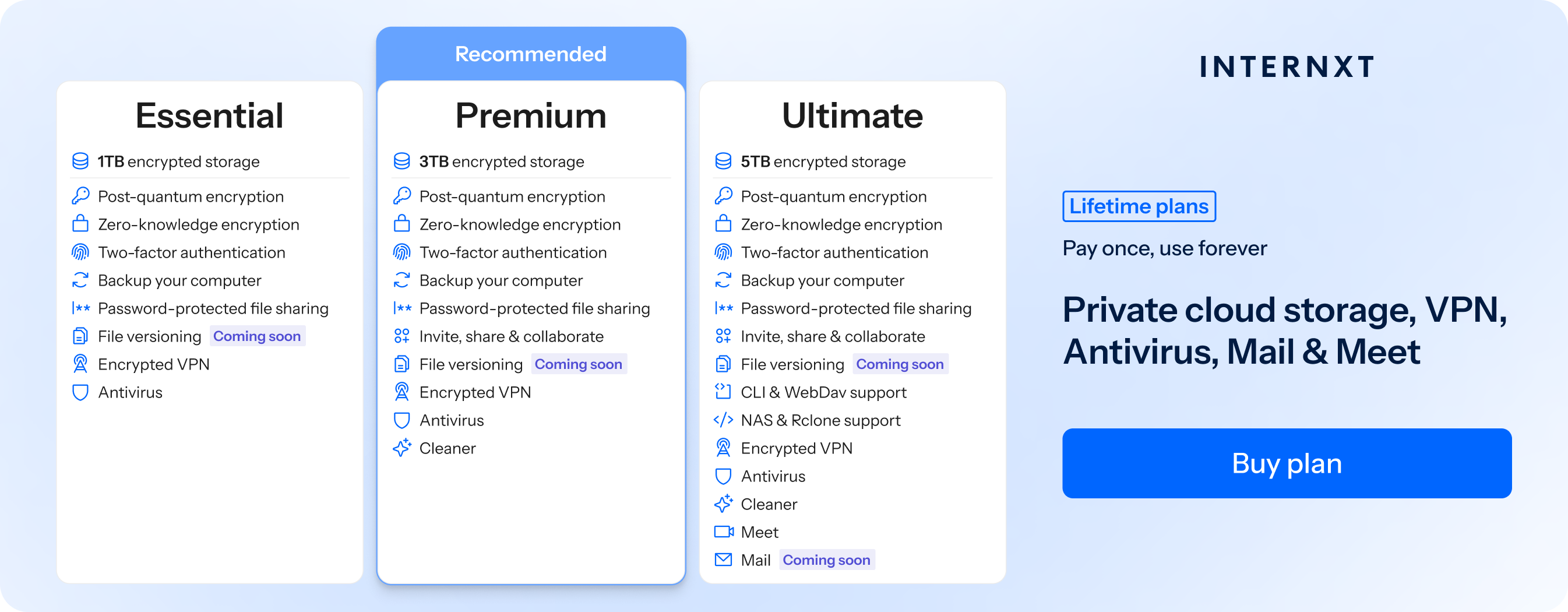
It also offers advanced sharing controls with password-protected file sharing for large videos or business projects, as well as WebDAV and Rclone support. Ultimate plans also include NAS support for QNAP and Synology, allowing you to set up your local and cloud storage together for increased security and privacy.
Aside from cloud storage, Internxt offers a full privacy suite for online and device protection with VPN, Cleaner, and Antivirus, with Meet and Mail also available.
To get started with Internxt, visit our website, check out our best cloud storage prices below, and get 85% off all our annual and monthly plans to get started.
| Plan | Storage | Features | Annual (Paid monthly) | Lifetime Cost |
|---|---|---|---|---|
| Essential | 1TB | €1.99/month | €380 | |
| Premium | 3TB |
|
€3.99/month | €580 |
| Ultimate | 5TB |
|
€5.99/month | €780 |
| *Prices are correct at the time of writing and are subject to change. For latest prices, check https://internxt.com/pricing | ||||
Internxt S3
For enterprise cloud storage, Internxt offers S3 cloud object storage to store petabytes of data, backup files, and access large amounts of data quickly.
Internxt S3 is a European-based object storage solution and alternative to AWS, Azure, and Google Cloud, offering a fixed storage plan of €7/TB/month, with no egress or ingress fees, offering an 80% cheaper alternative to these Big Tech companies.

All Internxt plans are GDPR, ISO 27001, HIPAA, and SOC 2 compliant, offering the best data protection and security for all types of data.
To get started with Internxt S3, you can visit our website to contact a member of our sales team to get the best cloud security, scalability, and affordable cloud storage for your business.
Also of interest to you...