
What is Data Encryption & How It Protects your Files

Data encryption is a complex, but crucial aspect to protect your data, either in the cloud, in your private cloud storage, or when you send messages, emails, or send or transfer any information via the internet.
To help simplify this topic, this article will cover:
- What is data encryption
- How encryption protects data
- Best way to protect and encrypt data
We will also cover the best encrypted cloud storage to protect your data in the cloud, and which encryption methods are best for your privacy.
Table of contents
- What is data encryption?
- Benefits of data encryption
- Different types of data encryption
- Data encryption algorithms
- Data encryption standards
- Can encrypted data be hacked?
- How Internxt Drive encrypts and protects your data
- Related articles
- Frequently asked questions
What is data encryption?
Data encryption is the process of converting readable information (plain text) into a coded form (ciphertext) so that only authorized people can access it. It protects data by making it unreadable to anyone who does not have the correct key to unlock it.
When data is encrypted, it looks like random characters instead of meaningful information, such as this example:
5b1d3f9a7c2e8d91a4f6b0c3e8d2f7a1
To turn it back into its original form, you need a decryption key.
Encryption is used everywhere in cloud storage, messaging apps, banking, and websites. It protects data when it is being sent over the internet and when it is stored on servers.
Benefits of data encryption
Prevents data breaches
As data encryption turns sensitive data into unreadable text, even if attackers gain access to a system, they cannot easily use the data, leak the data online, or use it in phishing or AI scams.
Supports compliance
By implementing encryption, businesses can meet and follow strict regulations to protect sensitive data.
To ensure maximum data security and protection, Internxt offers zero-knowledge and post-quantum encryption to meet GDPR compliance, HIPAA for healthcare data, ISO 27001 certification for establishing and maintaining a structured information security management system, and SOC 2 compliance, which verifies that the company has strong controls in place to protect customer data, ensure availability, maintain confidentiality, and guarantee data integrity.
Secures data at rest and in transit
In transit encryption protects your data when it is transferred over the internet to prevent man-in-the-middle attacks.
At rest encryption protects data in servers or anywhere the data is stored, to ensure nobody can access the data even if the systems are compromised.
Cloud storage protection
One of the biggest challenges for individuals, businesses, or enterprises is protecting data with secure cloud storage and backups.
While all cloud providers offer encryption, not all provide zero-knowledge protection, so in some cases, like with Google Drive, employees or law enforcement can access the files you store in the cloud.
This is why Internxt Drive and Internxt S3 cloud object storage encrypt files directly on your device to ensure maximum data protection, and secure cloud backups to protect against ransomware.
Protects intellectual property
Encryption also offers business security by protecting intellectual property by encrypting sensitive business data such as designs, research, and trade secrets, preventing unauthorized copying or theft.
Different types of data encryption
Symmetric (private encryption)
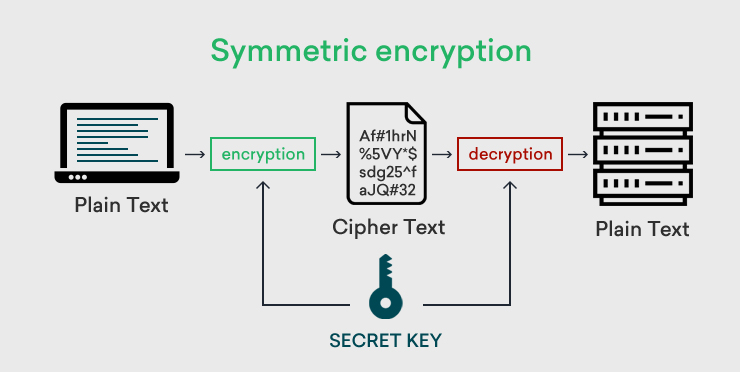
Symmetric encryption protects data with one single secret key that is used to encrypt data (turn it into ciphertext) and unlock information (return it to its original form).
This makes it very fast and efficient, which is why it is widely used to protect large amounts of data, such as files in cloud storage, databases, and backups.
The most common example of symmetric encryption is AES (Advanced Encryption Standard), especially AES-256, which is considered the standard for all data encryption methods.
Symmetric encryption is fast and strong for protecting data, but it depends heavily on keeping a single secret key safe.
To protect the secret key, cloud storage providers use separate data encryption keys that are protected by secure key management systems and hardware security modules, so the main keys are never directly exposed.
Asymmetric (public encryption)
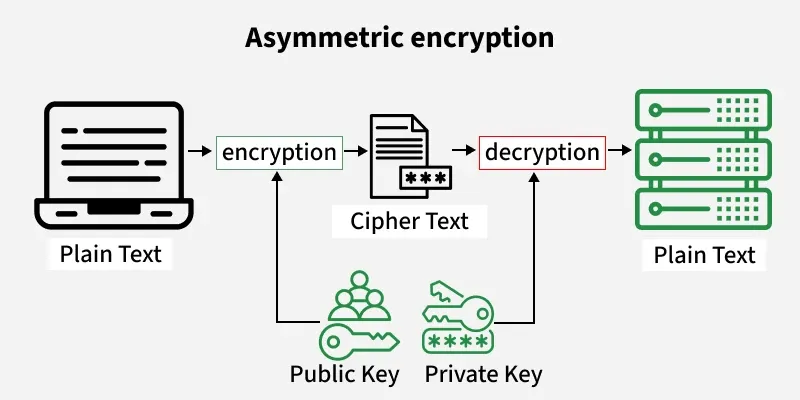
Asymmetric encryption is a method of protecting data that uses two different but mathematically linked keys: a public key and a private key.
The public key can be shared openly with anyone with multiple people and via the internet because only the owner of the private key can decrypt the information.
The most commonly used types of asymmetric encryption are:
- RSA = Rivest–Shamir–Adleman
- DSA = Digital Signature Algorithm
- ECC = Elliptic Curve Cryptography
Data encryption in transit
Data encryption in transit protects information while it is being sent between devices, servers, or online services.
It works by scrambling the data into a coded format that cannot be read by anyone who intercepts it during transmission. Only the intended recipient, who has the correct key to unlock the data, can read the original information.
For example, when you log into a website, send an email, or upload a file to the cloud, encryption in transit helps prevent hackers, internet providers, or other unauthorized parties from viewing or stealing your data as it travels across the internet.
This is commonly achieved using secure protocols such as HTTPS and TLS, which create a protected connection between you and the service you are using.
Data encryption at rest
Once your data reaches its destination, encryption at rest protects data when it is stored on a device, server, or cloud storage system. It converts information into an unreadable format, so if a server is compromised or a storage device is stolen, the encrypted data remains protected because it cannot be read without the key needed to unlock it.
Data encryption algorithms
Advanced Encryption Standard 256 (AES)
Advanced Encryption Standard 256, usually called AES-256, is a method used to protect data by turning it into unreadable code (ciphertext), so only someone with the correct key can unlock it.
It is a type of symmetric encryption and is the current encryption standard used by all major cloud storage companies, from when you encrypt a file in Google Drive to OneDrive.
The “256” refers to the size of the encryption key, which is 256 bits long. This makes it extremely difficult to guess or break using brute force methods, which is why it is considered very secure and is widely used by cloud providers and security systems around the world.
Elliptic Curve Cryptography (ECC)
Elliptic Curve Cryptography (ECC) is a method used to protect data and secure communication by using mathematical curves to create encryption keys, and is used by Proton Drive.
ECC is based on the difficulty of solving problems involving points on an elliptic curve. This makes it much more efficient while still being very secure.
In cloud systems, ECC is mainly used for key exchange and digital signatures, not for encrypting large files directly. It helps two systems securely agree on a shared secret key, which is then used with faster symmetric encryption like AES-256 to actually protect the data.
The main advantage of ECC is that it provides the same level of security as older systems like RSA, but with much smaller keys. This means faster performance, lower computing power, and less bandwidth usage, which is especially important in cloud storage, mobile devices, and large-scale systems.
Kyber 512 post-quantum encryption (PQE)
Kyber-512 is a post-quantum cryptographic algorithm designed to securely exchange encryption keys. The National Institute of Standards and Technology recommends that all companies switch to post-quantum encryption by 2035 to prevent the threats of quantum computers.
Today's data encryption systems, like ECC and RSA, are used to securely share encryption keys over the internet.
These rely on mathematical problems that are very hard for normal computers to break, but a sufficiently powerful quantum computer running algorithms like Shor’s algorithm could solve them much faster, effectively breaking the encryption that protects your data.
Kyber-512 avoids this risk by using a completely different kind of math called lattice-based cryptography.
Instead of relying on number factorization or elliptic curves, it is based on the difficulty of solving structured problems in high-dimensional grids of numbers. These problems are believed to remain hard even for quantum computers because there is no known efficient quantum algorithm that can solve them.
Due to the importance of future-proofing data from future cybersecurity threats, Internxt is the first encrypted cloud storage to protect your data with Kyber-512 and AES-256 encryption.
The major difference between Internxt Drive and other cloud companies is that Internxt combines PQE with zero-knowledge policies. This means all files are encrypted on your device, and only you hold the encryption keys, so nobody but you or those you share your files with can access them.
Even if law enforcement or government agencies requested access to your files, Internxt’s encryption makes this impossible, and all of Internxt’s security can be verified with its open source software.
Internxt’s data encryption and security have also passed an independent security audit by Securitum, a professional penetration testing company that also audits Proton, Bitwarden, NordVPN, and other privacy-focused services.
Choosing Internxt Drive gives you full privacy of your files, the most advanced encryption, and a future-proof way to store, backup, and share files in the cloud.
SHA-256 (hashing algorithms)
Hashing algorithms are different from data encryption, but still work to protect your data. While encryption hides your data, hashing algorithms verify that the data has not been altered.

In cloud storage, SHA-256 is used to check if data has been changed or corrupted. A file gets a hash when it is uploaded, and later the system checks it again. If the hashes match, the file is unchanged.
SHA-256 is also used in password security. For example, instead of storing actual passwords, systems store the hash of the password. When you log in, your entered password is hashed and compared to the stored hash. If they match, access is granted, but the system never needs to store or reveal the real password.
As Internxt uses zero-knowledge encryption, it cannot access your password, so for added account security, we recommend downloading a backup key to recover your account, which you can download when creating your Internxt account and following the steps below.
Data encryption standards
NIST
NIST data encryption standards are security guidelines created by the U.S. National Institute of Standards and Technology to define how data should be protected in government, industry, and cloud systems.
The most important current standard is AES, which NIST selected as the official standard for symmetric encryption. It is used to encrypt data at rest and in transit, with AES-128, AES-192, and AES-256 being the approved key sizes. AES-256 is the most commonly used for high-security systems.
Common Criteria (CC) for Information Technology Security Evaluation
Common Criteria does not create encryption rules, but it independently verifies how secure a product is and how well it uses encryption and other security mechanisms.
It is the international standard used to evaluate and certify the security of IT products, including encryption systems, software, and hardware.
Can encrypted data be hacked?
Data encryption can be hacked, and due to the sensitive nature of encrypted data, hackers try many ways to try and access data.
Common risks include:
- Accidental exposure: If the secret encryption key is accidentally exposed or fails to be protected, attackers can gain access to protected data.
- Social engineering attacks: the most common way cybercriminals attempt to access encrypted data is via social engineering, such as phishing attacks or AI scams.
- Insider threats: A severe threat to encrypted data is the possibility that an employee with high access levels will access sensitive data, or that data can accidentally be leaked.
- Malware: Attackers can compromise devices using malware and use it to decrypt data on your device.
So, although encryption is a strong and effective security measure, it should still be treated as another layer of protection that you must add additional security methods to, such as strong passwords and secure file sharing.
How Internxt Drive encrypts and protects your data
Internxt is the only cloud storage with Kyber 512 and AES 256 encryption, combined with zero-knowledge policies.
All data is encrypted on your device, so you don't need to know how to encrypt a file, as this happens automatically. Plus, you hold the encryption keys, so nobody but you can access your data.
Internxt Drive features include:
- Encrypted backups
- File syncing
- 2FA
- Password-protected file sharing
- Rclone, WebDAV, and NAS support
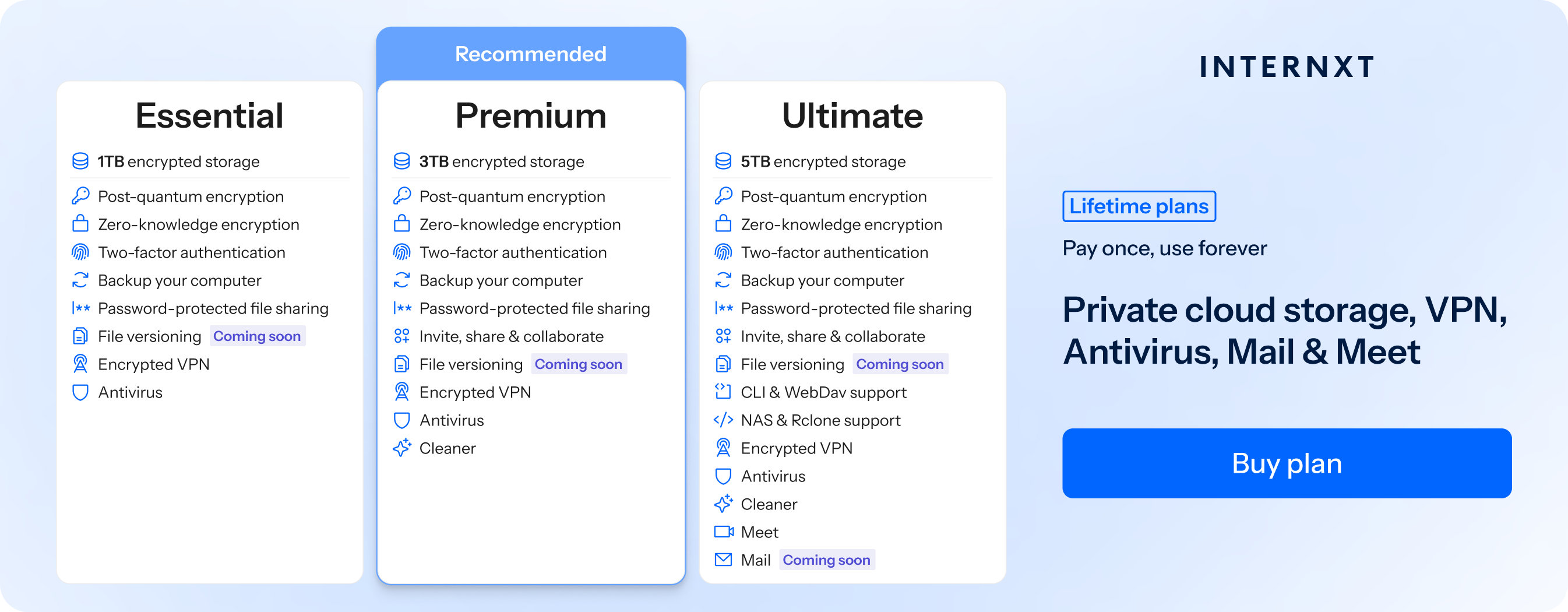
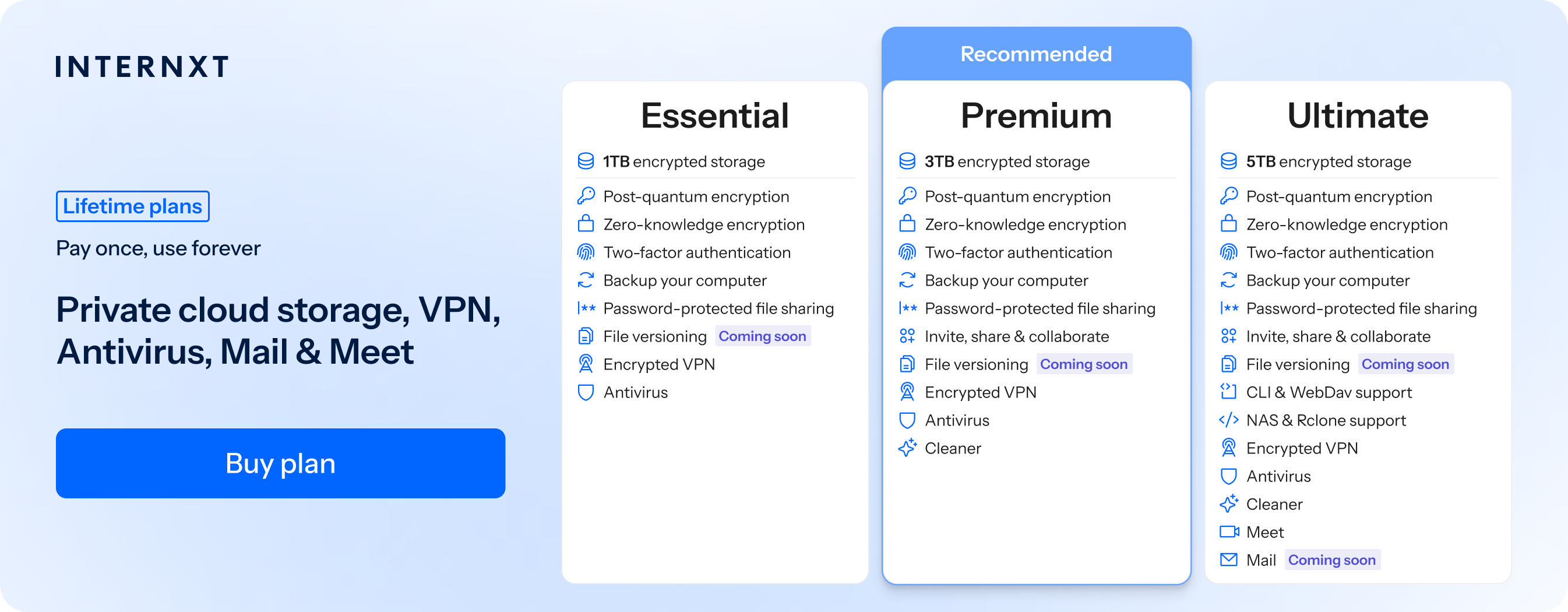
All plans include the same advanced encryption, and with paid plans, you can build a privacy-focused plan alongside your cloud storage with annual and lifetime plans, which you can get for 85% off by following the link below.
Related articles
 Fran Villalba Segarra
 Nathan James Turner
 Nathan James Turner
Frequently asked questions
Why is data encryption important?
Encryption protects sensitive information from unauthorized access, helping prevent data breaches, identity theft, and cyberattacks.
What is the difference between encryption at rest and encryption in transit?
Encryption at rest protects data stored on servers, devices, or cloud storage. Encryption in transit protects data while it is being transferred between systems or over the internet.
Can encrypted data be hacked?
Strong encryption is extremely difficult to break. However, weak passwords, stolen keys, or security vulnerabilities can still expose encrypted data.
What is a decryption key?
A decryption key is a secret piece of information used to convert encrypted data back into its original, readable form.
What is the difference between encryption and hashing?
Encryption can be reversed with the correct key to recover the original data. Hashing is a one-way process used to verify data integrity and cannot be reversed.
How does encryption protect cloud storage?
Encryption ensures that files stored in the cloud remain unreadable to unauthorized users, even if the storage system is compromised.
What is post-quantum encryption?
Post-quantum encryption uses cryptographic methods designed to remain secure against future quantum computers that could break some of today's encryption systems.
Does encryption affect performance?
Modern encryption has a minimal impact on performance. Most devices and cloud services are designed to encrypt data efficiently without noticeable slowdowns.
Is encrypted data completely secure?
Encryption greatly improves security, but it should be combined with strong passwords, access controls, and other security measures for maximum protection.
Which industries rely on data encryption?
Healthcare, finance, government, legal services, technology companies, and any organization that handles sensitive information rely on encryption to protect data and comply with regulations.