
Proton Mail vs Gmail: Convenience or Privacy?

If you’re looking for an end-to-end encrypted email, then you may be considering Proton Mail vs Gmail.
Proton offers end-to-end encryption, whereas Google only encrypts data in transit and on its servers.
But is Proton Mail the best alternative to Gmail?
You can find out more about both services in this article, as we cover:
- Proton Mail vs Gmail overview
- Proton Mail vs Gmail privacy comparison
- Proton Mail vs Gmail security comparison
- Pricing, features, and alternatives
If you’re looking for an alternative to Gmail, then you can learn more about Proton Mail vs Gmail from this article.
If you want the same end-to-end encrypted email as Proton, with the added benefit of post-quantum encryption, more cloud storage, and lifetime cloud storage plans, then you can learn more about Internxt Mail in this article too, or visit our website for more information.
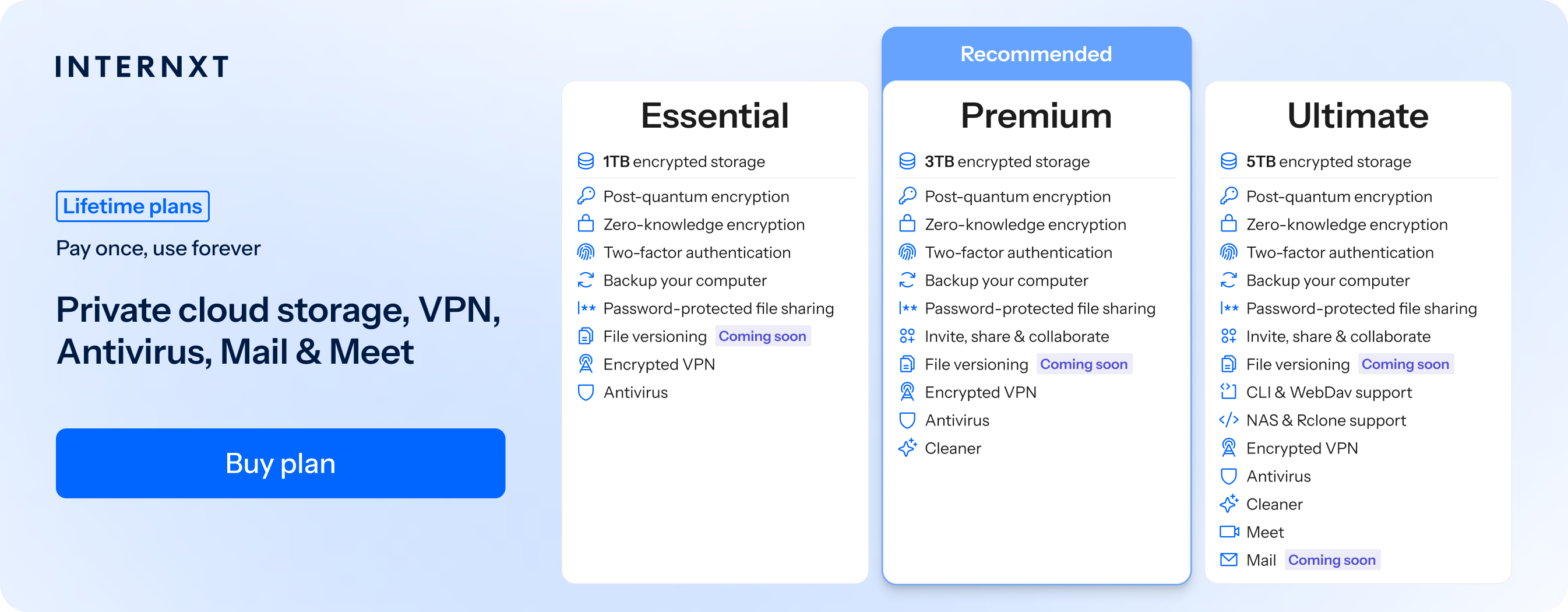
Table of contents
Proton vs Google overview
Proton and Google both offer a large collection of online services, including Proton Mail, Proton Drive, calendars, alternatives to Google Docs and Sheets, and a VPN. The main difference is their underlying approach.
Proton is built around privacy and encryption as its core principles; it uses end-to-end encryption, is open source, and is based in Switzerland, which is known for its strong privacy laws.
Google is built around a much broader ecosystem and is built for convenience, collaboration, search, and integration between many different services. In return for that convenience and integration, Google doesn’t use end-to-end encryption for Google Drive or Gmail.
This allows Google to process and analyze data on its servers to provide features such as powerful search, spam and malware detection, and real-time collaboration, but your personal data is used by Google as a result.
In short, Proton is primarily trying to give you a private version of the services you already use online, and Google is primarily trying to give you a highly integrated digital ecosystem.
| Feature | Proton Mail | Gmail |
|---|---|---|
| Main focus | Privacy and encryption | Convenience and integration |
| End-to-end encryption | Used extensively between Proton users and for certain encrypted features | Not used by default for normal Gmail messages |
| Provider access to email | Designed to minimize Proton's ability to access message contents | Google can process email content to provide the service |
| Advertising in inbox | No | No ads are shown in Gmail inboxes |
| Privacy-focused architecture | Yes | No, Google's model prioritizes broader functionality and integration |
| Open source | Proton publishes much of its software as open source | Google's core services are generally proprietary |
| Data processing | Designed to minimize access to user data | More extensive server-side processing enables additional features and integrations |
| Productivity features | Growing ecosystem focused on privacy | Extensive ecosystem with advanced productivity and collaboration features |
| Third-party integrations | More limited | Very extensive |
| Best suited for | Users prioritizing privacy and encryption | Users prioritizing convenience, integration, and productivity |
Proton Mail vs Gmail: What’s the difference?
Proton Mail and Gmail are the two email providers you can choose from and offer alternatives to Outlook, iCloud, or Yahoo.
Proton Mail is designed with end-to-end encryption as the default for your emails, so only you and your recipient can access the contents of confidential emails. Proton says its services do not contain advertising, and that Proton does not sell user data.
Proton is based in Switzerland and operates under Swiss law, which has similar data privacy controls for its customers as GDPR data protection offered by European tech companies like Internxt.
Gmail focuses heavily on integration with the Google Workspace, spam protection, search, and Gemini AI-powered features.
These features allow Gmail to analyze and process information within the service to provide things such as email summaries, suggested replies, natural-language searches, and assistance with drafting emails.
The result is a highly integrated and feature-rich email service that prioritizes convenience and functionality. However, this approach differs from Proton Mail's privacy-focused model, as Gmail's ability to provide many of these features depends on server-side processing and access to email data.
If you want a full privacy suite of mail and private cloud storage, with end-to-end encryption, then Internxt Mail offers encrypted email in its pricing plans that can meet the same privacy needs as Proton, with more privacy than you would get with Google.
Proton Mail vs Gmail pros and cons
Proton Mail pros
- Strong focus on privacy and data protection.
- End-to-end encryption.
- Zero-access encryption for stored emails.
- No advertising in Proton Mail.
Proton Mail cons
- Smaller ecosystem than Google.
- Fewer third-party integrations than Gmail.
- Some advanced features are less mature than Gmail's.
- Search functionality is affected by Proton's encryption architecture.
- If you send an email to someone not on Proton Mail, it won’t be E2EE encrypted by default.
Gmail pros
- Very strong spam, phishing, and malware protection.
- Extensive integration with Google Workspace.
- Works closely with Google Drive, Docs, Sheets, Calendar, Meet, and Chat.
- Strong AI integration through Gemini.
Gmail cons
- Gmail messages are not end-to-end encrypted by default.
- Google can process standard Gmail messages on its servers.
- Server-side processing enables features such as search, spam detection, indexing, AI, and integrations, but requires greater access to email data.
- Gmail's privacy model involves more data processing than Proton's zero-access approach.
- Some users have privacy concerns about Google's broader ecosystem and data practices.
Proton Mail vs Gmail free and pricing plan comparison
Proton Mail pricing
To start with a Proton Mail vs Gmail pricing comparison, we’ll start with the free plans.
Proton Mail offers a free plan for basic encrypted email use and includes:
- 1 GB storage
- 1 user
- 1 encrypted email address
If you want to upgrade, Proton offers two paid monthly or annual plans. The monthly costs are:
Mail Plus, €4.99/month
- 15 GB storage
- 1 user
- 10 encrypted email addresses
- Support for 1 custom email domain
- Unlimited folders and labels
- 10 hide-my-email aliases
- Priority customer support
Unlimited, €12.99/month
- 15 GB storage
- 1 user
- 10 encrypted email addresses
- Support for 1 custom email domain
- Unlimited folders and labels
- 10 hide-my-email aliases
- Priority customer support
Gmail pricing
Gmail offers 15GB of free storage, shared across Gmail, Google Drive, and Google Workspace, so if you want more free storage for your emails, Google offers 15GB for free, whereas Proton Mail Plus offers the same amount of storage for €4.99/month.
Google offers up to 2TB, while Proton offers up to 500GB with the Unlimited plan.
Google One pricing for its monthly plan are below.
| Google One Plans (Monthly) | Storage | First Three Months | After |
|---|---|---|---|
| Basic | 100 GB | €0.49 | €1.99 |
| Google AI plus | 400 GB | €1.29 | €4.99 |
| Google AI Plus | 2 TB | €2.49 | €9.99 |
| Google AI Pro | 5 TB | €5.49 | €21.99 |
Like Proton, Google offers savings if you pay annually, but neither offers a lifetime plan, so if you want an encrypted email with a one-time payment, Internxt offers the same zero-knowledge encrypted email with its lifetime cloud storage plans.
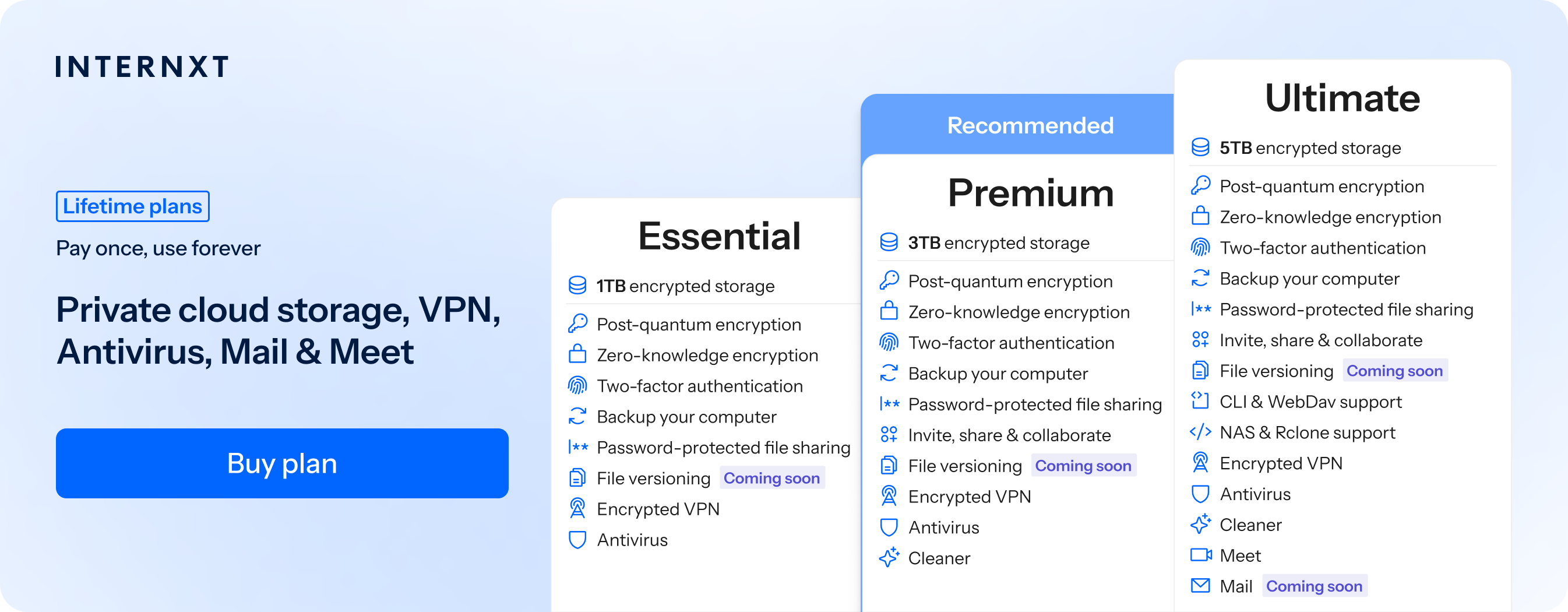
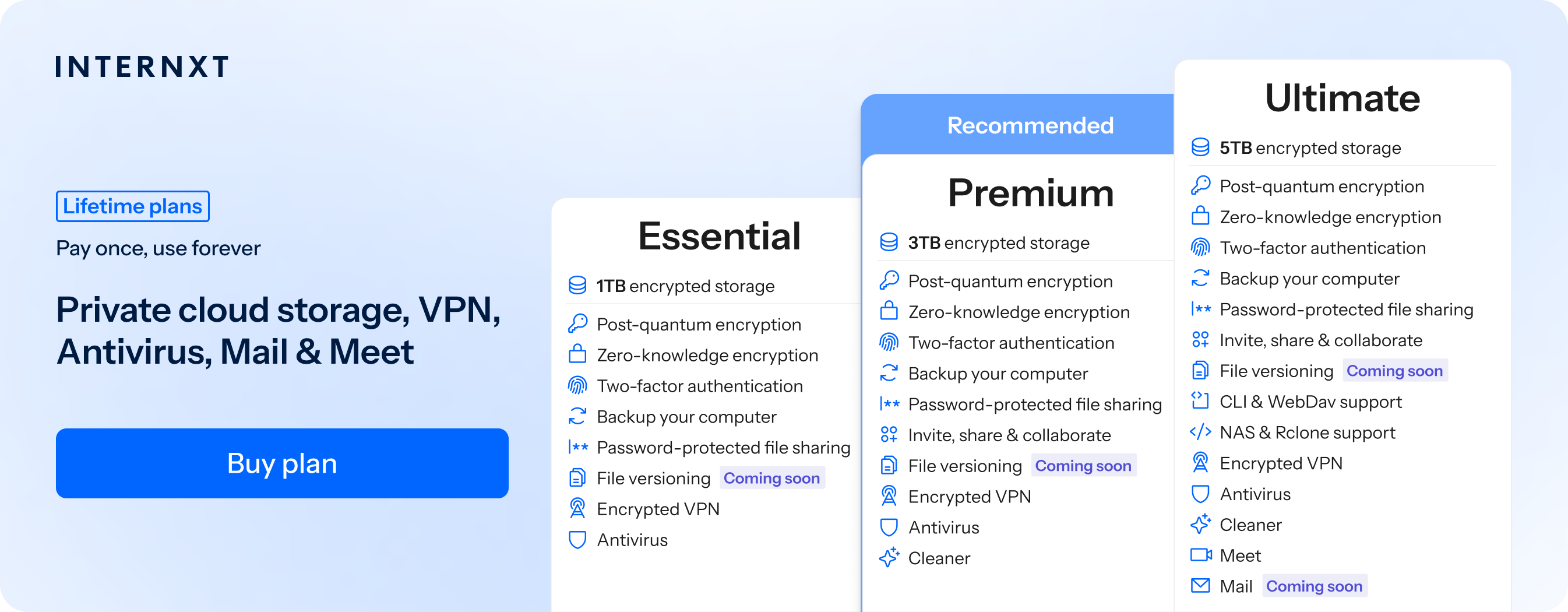
If you want lifetime access to 5TB of encrypted cloud storage, Mail, and more, then Internxt Ultimate plans include its full product suite for €4.49/ month.
Or you can avoid subscriptions completely with a lifetime cloud storage plan, starting from €285 with the Essential plan.
For the full Internxt product suite, which includes Mail, NAS, and Rclone support with full post-quantum encryption, get 85% off with the link below, where you can also check out the Internxt Essential, Premium, and Ultimate plans.
| Plan | Storage | Features | Annual (Paid monthly) | Lifetime Cost |
|---|---|---|---|---|
| Essential | 1TB | €1.99/month | €380 | |
| Premium | 3TB |
|
€3.99/month | €580 |
| Ultimate | 5TB |
|
€5.99/month | €780 |
| *Prices are correct at the time of writing and are subject to change. For latest prices, check https://internxt.com/offerblogen | ||||
Proton Mail vs Gmail: which is cheaper?
Based on the monthly costs, for Proton vs Gmail pricing, Google is cheaper when comparing both plans, as shown below.
- Google Basic (€1.99) gives you 100 GB versus Proton Mail Plus at €4.99 for 15 GB.
- Google AI Plus (€4.99) costs the same as Mail Plus but gives 400 GB, compared with Proton's 15 GB.
- Google AI Plus (€9.99) gives 2 TB, while Proton Mail Plus remains 15 GB.
- Google AI Pro (€21.99) gives 5 TB plus Google's AI features and other benefits.
Choose Google One plans if you want better value for money if you're judging price, storage, and the number of features/services included.
Proton Mail is more expensive per GB, but choose this as a Gmail alternative.
Choose Internxt if you want 5TB of storage, VPN, Mail, and post-quantum encrypted services for maximum online privacy and security.
Proton Mail vs Gmail privacy comparison
End-to-end encryption
This is the main difference when deGoogling from Gmail and looking for a Google Drive alternative.
Google does not offer end-to-end encrypted storage, email, or Google Photos. Instead, it encrypts data in transit and at rest on its servers, meaning Google could access your files, emails, or photos.
When you make a new email with Internxt and Proton, end-to-end encryption as is included for all email messages you send, so there's no need to learn how to send an encrypted email with additional setup or configurations. Internxt and Proton encrypt your messages directly on your device so nobody but you can see them.
Emails sent outside Proton
Proton's E2EE protection is strongest when both recipients use Proton Mail accounts
If you send a normal email from Proton to Gmail, Yahoo, Outlook, etc., it is not automatically end-to-end encrypted. Proton offers password-protected emails and PGP for situations where you need E2EE with external recipients.
Likewise, if someone sends a normal Gmail email to Proton, it is not end-to-end encrypted, so Proton can receive the unencrypted message before storing it with zero-access encryption.
Gmail's server-side processing
Gmail doesn’t offer end-to-end encryption because it needs to analyse certain data to provide more advanced features such as:
- Spam and phishing protection
- Malware detection
- Email categorization
- Smart Reply and Smart Compose
- AI-assisted features
- Integration with other Google services
Gmail's architecture allows more server-side processing, while Proton and Internxt’s encryption architecture is designed to keep the contents of stored emails totally private.
Advertising
Neither Internxt nor Proton Mail uses advertising in their products; other big tech companies, like Outlook, show ads in the free plan, and Google uses how you interact with its services to show you personalised ads in Chrome, YouTube, and more.
Proton Mail vs Gmail security comparison
Account security
Proton Mail secures accounts with passwords, two-factor authentication, passkeys, recovery methods, session management, and protections against suspicious login attempts.
Gmail secures accounts with passwords, two-step verification, passkeys, security keys, login alerts, suspicious-login detection, session controls, and automated systems that detect and block potentially malicious activity.
Google also provides advanced security options such as Advanced Protection for users who need stronger account safeguards.
Open source
Like Internxt Mail and its other products and apps, Proton Mail is open source and is available to the public and security experts to check the code for potential security vulnerabilities or to check that there are no backdoors to user data.
Gmail is proprietary software, so its complete source code is not publicly available for inspection, meaning you have to trust Google that its software is implemented securely and that its security mechanisms work as they state.
Audited
Proton has been audited by Securitum, the same cybersecurity company that also audited Internxt, to verify that both services and infrastructure are secure, up to date, and that your data is protected from hackers.
Google conducts independent audits and assessments of its infrastructure and Google Workspace services against recognized security and compliance standards.
Compliance
Proton complies with the Swiss Federal Act on Data Protection (FADP) and the revised Swiss Federal Act on Data Protection (revFADP), and provides GDPR-related protections for European users.
Google provides GDPR compliance commitments and contractual protections, including a Data Processing Amendment, and supports GDPR rights such as access, deletion, rectification, restriction, objection, and data portability.
Despite being GDPR compliant, Google has paid millions in fines due to violations of GDPR data handling practices relating to consent, so if you need a European cloud storage provider that protects your data in line with GDPR, HIPAA, ISO, and SOC 2, then Internxt is a secure and private option for your email and cloud storage.
Internxt vs Proton Mail vs Gmail: Which one should you choose?
When comparing Proton Mail vs Gmail, it’s important to note that both have different priorities, so the better fit depends on what you need from your online services.
Choose Proton Mail if you want Swiss-based data protection and end-to-end encryption for your emails.
Choose Gmail if you want integration with services such as Google Drive, Google Calendar, Google Meet, and Google Workspace.
Choose Internxt if you want to send an encrypted email protected with post-quantum cryptography, with 5TB of lifetime cloud storage, advanced cloud management with QNAP or Synology devices, and more.
Related products
Frequently asked questions about Proton Mail vs Gmail
Is Proton Mail more private than Gmail?
Proton Mail is designed with a stronger focus on privacy. It uses end-to-end encryption for messages between Proton users and zero-access encryption for stored mailbox data. Gmail encrypts messages in transit and at rest but does not provide end-to-end encryption for standard Gmail messages.
Is Proton Mail more secure than Gmail?
Both provide strong account security features such as two-factor authentication, passkeys, security alerts, and protection against suspicious logins. Their security models differ mainly in how they handle encryption, data access, and integration with other services.
Is Proton Mail safer from hackers than Gmail?
Neither service can guarantee that an account will never be compromised. Both provide security features designed to prevent unauthorized access, including multi-factor authentication, phishing protection, suspicious-login detection, and account recovery controls.
Does Proton Mail have end-to-end encryption?
Yes. Proton Mail automatically provides end-to-end encryption when both the sender and recipient use Proton Mail. Messages sent to external email providers can also use password-protected encryption.
Does Gmail have end-to-end encryption?
Standard Gmail does not provide end-to-end encryption for ordinary personal emails. If you want end-to-end encrypted emails with post-quantum encryption, Internxt is the best encrypted email for your privacy.
Which has better account security, Proton Mail or Gmail?
Both provide strong account-protection mechanisms. Proton Mail and Internxt Mail emphasize privacy-focused authentication and encryption, while Gmail provides extensive security controls including passkeys, security keys, suspicious-login detection, and Google's broader account-security infrastructure.
Can Proton Mail read my emails?
Proton states that its zero-access encryption prevents it from accessing the contents of encrypted messages stored in your mailbox. However, messages that Proton can decrypt, such as certain messages received from external providers, may not have the same protection.
Can Google read my Gmail emails?
Standard Gmail is not end-to-end encrypted, so Google technically has access to message content within its systems. There are options for confidential mode, but this is not the same as true end-to-end encryption.