
The Key Differences between a Sovereign Cloud vs Private Cloud

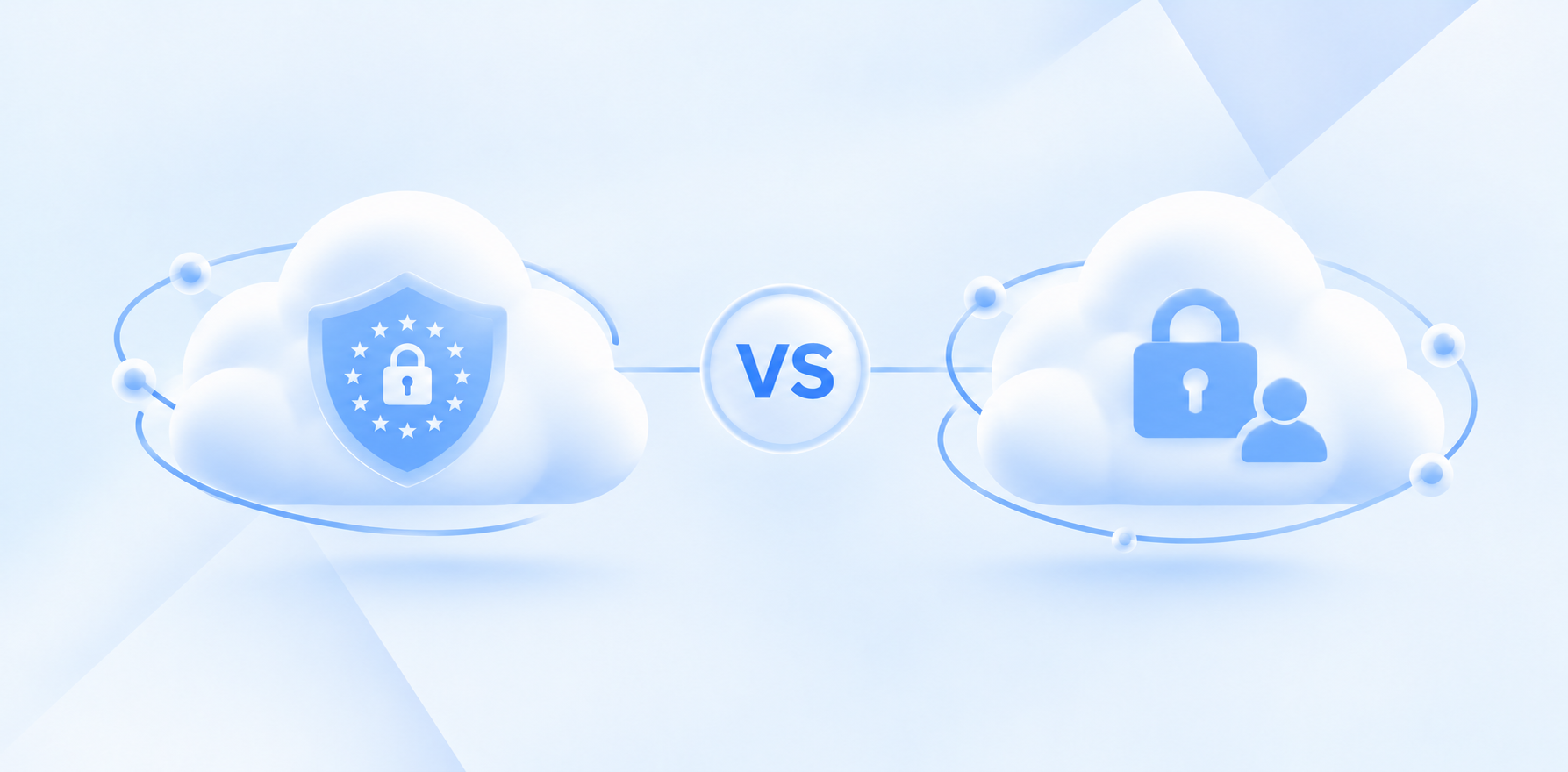
Cloud storage solutions offer different levels of control, security, and data protection, making it important to understand which option best suits your needs, whether it's for personal, business, or enterprise cloud storage.
Sovereign cloud and private cloud are two popular choices, but they serve different purposes.
While a sovereign cloud focuses on data location, legal jurisdiction, and regulatory compliance, a private cloud solution provides dedicated infrastructure and greater control over resources.
In this article, we explore the key differences between a sovereign cloud vs private cloud, their advantages and disadvantages, and how to choose the best sovereign or private cloud solution to meet your storage, backup, or compliance needs.
Table of contents
- Why learning the difference between sovereign vs private cloud is important
- Key differences between a sovereign cloud vs private cloud
- Private cloud vs sovereign cloud pros and cons
- Best sovereign cloud providers
- Frequently asked questions about a sovereign cloud vs private cloud
Why learning the difference between sovereign vs private cloud is important
Understanding how private cloud vs sovereign cloud storage works is important to understand how the protection, control, and ownership of your data work.
Choosing the right types of cloud storage for personal, business, or enterprise needs ensures you keep data secure and private, and information is stored according to regulatory requirements or local laws.
Once the differences are clear, the decision of choosing between sovereign cloud vs private cloud providers helps you pick the right one to store sensitive information securely in the cloud.
Cloud computing and sovereign vs private cloud differences
Sovereign cloud vs private cloud overview
Below are the main differences and overview of a private cloud vs sovereign cloud solution.
Feature |
Sovereign cloud |
|---|---|
Main focus |
Data sovereignty and legal control |
Definition |
Data is stored, processed, and managed under the laws and regulations of a specific country or region. |
Data location |
Data is stored and processed according to geographical and legal requirements. |
Legal jurisdiction |
subject to the laws of a specific country or region. |
Infrastructure |
Dedicated or shared infrastructure. |
Data access and control |
Focuses on who can access data and which legal authorities have jurisdiction over it. |
Main purpose |
Protect data sovereignty, meet regulatory requirements, and reduce exposure to foreign jurisdictions. |
Typical users |
Governments, healthcare organisations, financial institutions, etc. |
Key difference: A sovereign cloud focuses on where data is stored, which laws apply to it, and who has legal authority over it. A private cloud focuses on ensuring that the infrastructure and resources are dedicated to a single organisation.
A cloud environment can be both sovereign and private if it uses dedicated infrastructure and meets the data sovereignty requirements of a specific country or region.
What is a sovereign cloud?
Sovereign cloud providers offer a cloud computing environment where data is stored, processed, and managed according to the laws and regulations of a specific country or region, such as Europe.
It ensures organisations maintain control over their data, including where it is stored and who can access it, and keeps data within national borders and protected from foreign access.
To learn more about sovereign cloud, visit our what is a sovereign cloud article.
Sovereign cloud use case: A Spanish healthcare company may choose a Spain-based sovereign cloud provider that stores and processes all its patient data within the European Union, such as Internxt S3, which also offers HIPAA compliance for sensitive healthcare data and medical records.
What is a private cloud?
Unlike a sovereign cloud, a private cloud is a cloud computing environment dedicated to a single organisation, and the storage, servers, and computing resources are managed by the company rather than a third-party cloud provider.
This allows businesses to customise their infrastructure, establish their own security policies, control who can access their data, and manage how their resources are used. A private cloud can be hosted on the organisation's own servers or managed by an external cloud provider.
Private cloud storage use case: a large bank may use a private cloud to store customer records, financial transactions, and internal business documents. Because the infrastructure is managed by the bank, it can configure its own security policies, manage user access, and customise the environment to meet its specific security requirements.
What is a public cloud?
A public cloud is a cloud storage service that allows individuals to store their files, photos, videos, and documents online using infrastructure managed by an external provider. The cloud infrastructure is shared between multiple customers, but each user has their own private account and storage space, protected by individual login credentials and security measures.
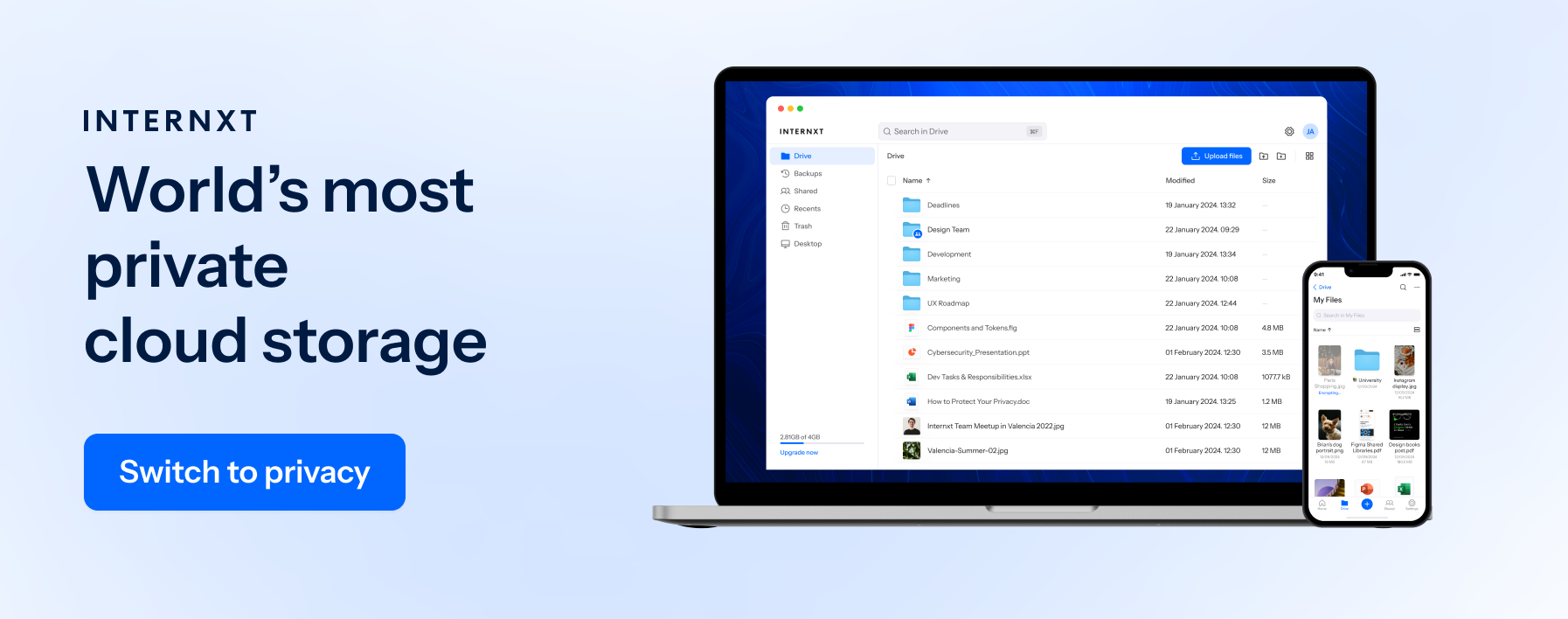
Public cloud providers include Google Drive, Dropbox, and Microsoft OneDrive, but for a sovereign personal cloud provider, Internxt Drive offers end-to-end encrypted cloud storage for maximum privacy and control over data privacy.
For businesses, a company may use Amazon Web Services (AWS), but companies have less control over the infrastructure, where data is stored, and which country’s laws govern it.
The main advantage of public cloud storage is its convenience, accessibility, and affordability. However, users have less control over the underlying infrastructure, where their data is stored, and which country's laws govern it.
Other types of cloud storage
Aside from knowing the importance of sovereign cloud vs private cloud providers, it’s also important to know the other types of cloud storage that may be suitable for your business or personal needs, which include:
- On-premises: An organisation owns or manages its own physical servers and storage systems, which are located at its offices or in its own data centre. The organisation is responsible for maintaining the hardware, security, and infrastructure.
- Hybrid: A hybrid cloud combines two or more types of cloud environments, typically a private cloud or on-premises infrastructure with a public cloud. This allows an organisation to store and manage highly sensitive data in a private cloud, and less confidential data in a public cloud.
An on-premises cloud solution offers maximum control for companies in terms of security, control, and security, but requires a high investment and ongoing maintenance.
Hybrid cloud storage is useful for companies that want the control of private infrastructure with the flexibility of public cloud services, but it can be more complex and requires careful integration and security management.
Key differences between a sovereign cloud vs private cloud
The main difference between a sovereign cloud and a private cloud is what they prioritise.
A sovereign cloud focuses on where data is stored, which country's laws apply to it, and who has legal authority over it.
A private cloud focuses on providing dedicated infrastructure and resources exclusively to one organisation.
Although they are different, a cloud environment can be both sovereign and private if it meets both sets of requirements.
Private cloud vs sovereign cloud pros and cons
When it comes to private cloud vs sovereign cloud providers, both have their advantages and disadvantages, depending on your experience working with a private cloud or the local laws you have to follow.
Private cloud pros and cons
Private cloud storage solutions offer the following benefits or possible limitations depending on your needs.
Private cloud pros
- Greater control over infrastructure, data, and security policies.
- Dedicated resources that are not shared with other organisations.
- Customisable to meet specific business requirements.
- Greater flexibility in managing user access and security.
- Can be hosted on-premises or by an external provider.
Private cloud cons
- Higher setup and maintenance costs. (approximately 10,000 - 100,000+ for initial setup, depending on the organisation's size and infrastructure, plus ongoing maintenance costs).
- Requires technical expertise to manage and maintain.
- The organisation may be responsible for infrastructure updates and security.
- Less scalable than public cloud solutions in some cases.
- Does not automatically guarantee data sovereignty or protection under a specific country's laws.
You should choose private cloud storage when you need dedicated infrastructure, greater control over your data and security settings, and the ability to customise your cloud environment to meet your organisation's specific requirements.
Sovereign cloud pros and cons
Sovereign cloud pros
- Data is stored and processed according to the laws of a specific country or region.
- Helps organisations meet data protection and regulatory requirements.
- Provides greater control over data location and legal jurisdiction.
- Reduces exposure to foreign laws and jurisdictions.
- Supports data privacy and digital sovereignty.
Sovereign cloud cons
- May involve higher costs due to specific legal, infrastructure, and operational requirements.
- Can limit the choice of cloud providers and services.
- Data residency requirements may restrict where data can be stored or processed.
- Compliance requirements can increase administrative complexity.
- Does not automatically guarantee dedicated infrastructure or exclusive access to resources.
You should choose sovereign or European cloud service providers if you need to ensure your data is stored and processed within a specific country or region, remains subject to its laws and regulations, and is protected from exposure to foreign jurisdictions.
Best sovereign cloud providers
Internxt
Internxt is a Spanish-based cloud storage company offering GPDR cloud storage for personal, business, or enterprise use. It also offers compliance with ISO 27001, SOC 2, and HIPAA, offering data protection for all industries.
With Internxt, your data is stored in multiple European data centers, and is protected by post-quantum, end-to-end encryption. For full transparency, Internxt and all its products are open source, and available for independent reviews by security experts.
Internxt S3 is an enterprise cloud object storage solution for enterprises, offering scalable storage for businesses at a fixed cost of €7/TB/month to store petabytes of data for your storage, backups, or file versioning needs.
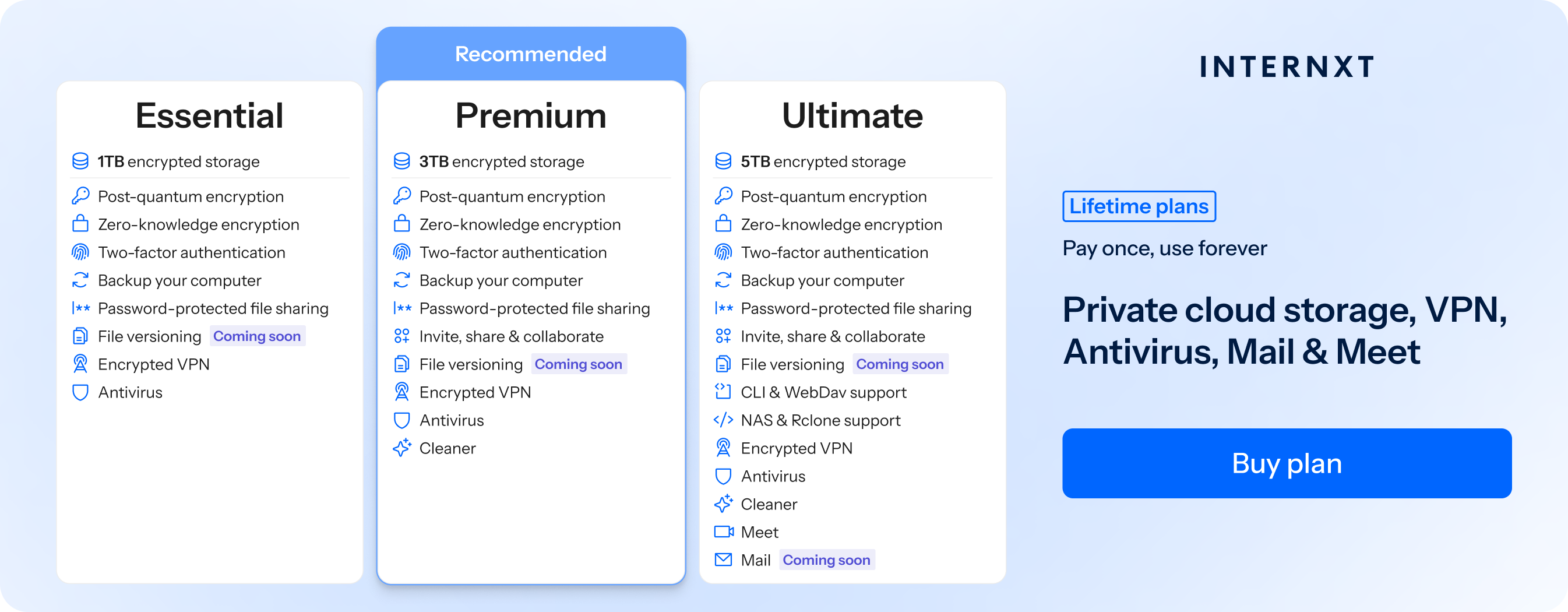
Internxt Drive is an end-to-end encrypted product suite including Mail, Meet, and Photos, to meet your online privacy and secure cloud storage needs. Monthly and lifetime plans are available, with each paid plan offering backups and VPN, with more advanced features available such as WebDav and Rclone support.
You can also combine your private NAS cloud storage by connecting your Internxt Drive to your NAS system, to combine privacy and maximum control of your data.
To get started with Internxt S3, visit our website to contact a member of our sales team, and for Internxt Drive, get started by choosing any paid plan, and claim your exclusive 85% discount below.
| Plan | Storage | Features | Annual (Paid monthly) | Lifetime Cost |
|---|---|---|---|---|
| Essential | 1TB | €1.99/month | €380 | |
| Premium | 2TB |
|
€3.99/month | €580 |
| Ultimate | 5TB |
|
€5.99/month | €780 |
| *Prices are correct at the time of writing and are subject to change. For latest prices, check https://internxt.com/offerblogen | ||||
Frequently asked questions about a sovereign cloud vs private cloud
What is the difference between sovereign cloud and private cloud?
A sovereign cloud focuses on where data is stored, which laws apply to it, and who has legal authority over it. A private cloud provides dedicated infrastructure and resources exclusively to one organisation. The main difference is data sovereignty versus infrastructure exclusivity.
What is a sovereign cloud?
A sovereign cloud is a cloud environment where data is stored, processed, and managed according to the laws and regulations of a specific country or region. For example, European cloud service providers such as Internxt gives organisations and individuals greater control over data location and legal jurisdiction.
What is a private cloud?
A private cloud is a cloud computing environment dedicated to a single organisation. Its infrastructure and resources are not shared with other customers, giving the organisation greater control over security, access, and customisation.
Which is better: sovereign cloud or private cloud?
Neither is universally better. A sovereign cloud suits organisations that prioritise data location, legal jurisdiction, and regulatory compliance. A private cloud suits organisations that need dedicated infrastructure and greater control over their cloud environment.
What are the benefits of sovereign cloud storage?
Sovereign cloud storage helps organisations maintain control over where their data is stored and which laws govern it. It can support regulatory compliance, protect data privacy, and reduce exposure to foreign jurisdictions.
What are the benefits of private cloud storage?
Private cloud storage provides dedicated resources, greater control over security policies, and the ability to customise the infrastructure. It also allows organisations to manage access to their data according to their specific requirements.
Is sovereign cloud more secure than private cloud?
Not necessarily. Both can provide strong security, but they address different priorities. Sovereign cloud focuses on data jurisdiction and legal control, while private cloud provides dedicated infrastructure and greater control over security configurations.