
What Is Online Privacy and Why Is It Important?

As more services, communication, and daily activities move online, the amount of personal data being collected continues to grow. So what can we do to make sure that protecting our privacy doesn’t become unmanageable?
To make the topic of online privacy easier to understand, we will break it down into the following topics:
- What is online privacy?
- Why online privacy is important
- Difference between privacy, security, and anonymity
- Common threats we face online
- Tools and methods to protect your online
By the end of this article, you will know how to take control of your privacy, secure your accounts, keep your information safe, and share this knowledge with others, so we all can enjoy more freedom online.
Table of contents
- What is online privacy?
- What is online privacy, security, and anonymity?
- Is online privacy a myth?
- Threats to your online privacy
- How Internxt protects your data and online privacy
- Related articles
- Frequently asked questions
What is online privacy?
Your online privacy is the level of protection related to your personal information when you’re connected to the internet, signed in to social media, playing video games, or using any other services online.
In general, your online privacy refers to the following:
- Personal data protection: keeping information such as your name, email, location, and financial details from being misused in phishing or other kinds of online scams.
- Browsing privacy: preventing websites, advertisers, or others from tracking what you do online.
- Communication privacy: protecting emails, messages, and calls from unauthorized access.
- Data control: having the ability to decide what information you share and who can access it.
1.** Security measures:** using tools like encryption, secure connections, and strong passwords to protect your information.
However, not all websites or services you use online are private. They could be tracking your activities, viewing your files, emails, WhatsApp messages or using your data to target you with personalized advertising.
To help give users more control over their data, in Europe, the GDPR exists to make sure companies are clear about what data they collect, how they use it, and who they share it with.
It also gives people rights such as accessing their data, correcting errors, deleting data, restricting its use, and withdrawing consent.
Even so, companies like Google have paid millions in GDPR fines for the mishandling of user data. So, unfortunately, while the GDPR exists, you still have to take measures to protect your privacy.
Luckily, companies like Internxt are creating services and tools to keep your online privacy protected. Internxt Drive was developed as a private Google Drive alternative, and now extends to a range of privacy-focused products such as Antivirus, VPN, Meet, Mail, and more.
It’s important to note that when asking what is online privacy, anonymity and security are also mentioned when covering this topic, so we will explain the differences between these below, so you have a clear picture of everything you need to protect your data online.
What is online privacy, security, and anonymity?
Privacy, security, and anonymity online are all closely related but slightly different. Nevertheless, when you understand these, you will have greater control over your presence online and will understand when to protect your privacy, secure your accounts, and remain anonymous online.
First, let’s answer what is online privacy and security.
Online privacy
Online privacy is how you control and protect personal information while using the internet. It focuses on keeping data such as your name, email, location, and online activity private and deciding who can access or see it.
Example: adjusting your social media settings so that only friends can view your posts and personal information.
Online security
Online security, on the other hand, is the practice of protecting devices, networks, and data from unauthorized access, attacks, or theft. Online security often involves technical measures like cryptography, secure passwords, firewalls, and antivirus software to prevent hackers or malware from compromising your information.
Example: using two-factor authentication or biometrics to prevent someone from logging into your email account even if they know your password.
Online anonymity
Finally, anonymity is similar to online privacy and security in that it helps protect personal information and maintain safety online.
Whereas online privacy and security are about protecting your information, online anonymity is about hiding or removing your identity entirely so nothing can be linked back to you.
Example: People who need to care about their anonymity include journalists reporting sensitive information, activists or whistleblowers exposing wrongdoing, or individuals living under restrictive governments.
They will use tools like a VPN, encrypted email, or Tor browser to ensure no personal information is connected to their online activities.
Is online privacy a myth?
While it may seem that we are doomed to handing over our personal information to the companies we use or subscribe to, online privacy is possible, available to everyone, and is easy to achieve with the right methods and tools available, such as
- Password generator: Instantly create a strong password or passphrase for your accounts
- Temporary email: Sign up for services while keeping your personal email private and safe from spam
- VPN: Encrypt your wifi connection and hide your IP to prevent hackers from accessing your accounts or companies from monitoring your online activity
These are all available for free with Internxt, and to realise the importance of online privacy, we must realise what threats we face online, which we will examine below.
Threats to your online privacy
Weak and reused passwords
Your passwords are your first line of defence for all your personal information, emails, bank accounts, and pretty much everything we use online. If your password is weak, hackers can easily break it using advanced software or dictionary attacks.
If you reuse your password, then hackers can access all your other accounts and easily steal your identity, finances, and more.
The top 10 most common passwords for all countries are:
- 123456
- admin
- 12345678
- 123456789
- 12345
- password
- Aa123456
- 1234567890
- Pass@123
- admin123
Weak passwords can also be information linked to you personally, such as your birthday, children’s names, etc.
To check the strength of your passwords, you can use Internxt’s Password Generator for free, and our free password and passphrase generator to ensure your accounts have the best protection available.
Combine these with two-factor authentication, and you will have the best protection for your accounts to prevent identity theft and other cyberattacks.
Unsecure browsing
Unsecured browsing, such as using public wifi without a VPN, has a major risk to your online privacy because it exposes your personal information, location, and online activities to interception or misuse.
When you visit websites without secure connections, such as sites using HTTP instead of HTTPS, the data you send, like login credentials, credit card numbers, or messages, can be captured by hackers or malicious actors on the same network.
Unsecure browsing also makes it easier for trackers, advertisers, or even cybercriminals to monitor your behavior, collect sensitive information, or inject malicious content. This compromises your privacy by revealing personal details that you may not want others to access.
Even the most popular browser, Google Chrome, comes with risks to your privacy. Chrome collects a lot of information about your browsing activity, including:
- Websites you visit
- Search queries
- Location data (if allowed)
- Device and usage information
- Third-party cookies and trackers by default, which advertisers can use to follow you across multiple sites.
With this information, companies and trackers collect detailed information about your behavior, interests, and location, which can be misused or leaked online in a data breach.
For more private browsers, check out our list of Google Chrome alternatives.
Social media
Although social media has its benefits and helps us stay connected, it encourages people to share personal information, such as photos, locations, and contact details, which can be collected, tracked, or misused.
Platforms often monitor your activity to target ads, build detailed profiles, and share data with third parties.
Even private posts or accounts can be exposed through hacks, data leaks, or platform policies, making your personal information vulnerable to misuse.
AI
Artificial Intelligence, like social media, has also become the norm in our day-to-day lives. Like social media, it also comes with risks to your personal information if you’re not careful.
Gemini AI chats are observed by employees at Google, Grok AI scans and uses your posts on Twitter / X to train its language model. Other risks of AI include:
- Data profiling
- Targeted advertising
- Surveillance
- Data leaks of AI chats
Other risks of AI recently involve creating deepfake videos or audio in AI scams targeting businesses and their employees.
For a secure and private alternative to ChatGPT, Internxt AI is a free and encrypted chatbot that doesn’t use your data and encrypts your chats on your device, so all information is kept confidential and private.
Outdated software
For your phones, tablets, laptops, and any software you have downloaded on your computer, you must check that you have the most recent software updates installed.
Outdated software could be vulnerable to security vulnerabilities patched in recent updates that hackers will use to install ransomware or other harmful spyware on your device.
How Internxt protects your data and online privacy
Internxt was founded on a mission to provide a safer internet where everyone has control over their privacy, without big tech companies profiting off our personal information.
Internxt started with its first product, a secure and encrypted cloud storage, Internxt Drive, in 2020, and has since expanded its product suite to include Antivirus, VPN, Meet, and Cleaner. Later in 2026, Internxt Photos and Mail will also be live, giving you everything you need to live a more private life online.
For more information about our values and privacy mission, you can visit our website, or keep reading to learn more about how our tools and products keep you safe online.
Post-quantum, zero-knowledge encryption
Internxt released post-quantum encryption for Drive in late 2025, making it the first cloud storage to have this most advanced encryption available.
It protects your data from future threats of quantum computers, which could theoretically decrypt current encryption methods used by other cloud storage services.
PQE, combined with zero-knowledge encryption, ensures all the files you store in Internxt Drive can only be viewed by you; nobody, not even Internxt, or any government or law agencies, can access your files.
If you’re worried about the privacy of your photos and videos in the cloud, then switch to Internxt.
Dropbox, Google, and others manage the encryption keys to your device, so unlike Internxt, their employees or law enforcement could not access your files in the cloud with these keys.
Drive also allows you to share files with the same private encryption, or you can use Internxt Send, a private WeTransfer alternative, which allows you to encrypt and send large video files, or any other files of up to 5GB for free.
Open source software
Internxt is one of the few cloud storage providers that is 100% open source. The code that develops Internxt and all its apps and products is available online for anyone to see.
By offering total transparency, anybody can check and verify that Internxt has the necessary security to protect your files, and there are no backdoors that could give anyone access to your data or files.
Independently audited
Internxt has also been security tested and independently audited by Securitum, who have audited other privacy-focused companies such as Proton and DuckDuckGo.
Internxt has been audited by Securitum twice, and both times passed the security audits to verify the platform as secure from data breaches and hackers.
Compliance
As we mentioned before, GDPR compliance is an important part of how companies protect your data and online privacy. As Internxt is based in Spain, it complies with these standards to ensure you have full control over your data.
Beyond that, Internxt also complies with SOC 2, ISO 27001, and HIPAA, so no matter what information you store with Internxt, you can feel confident that the necessary standards and security are met to keep your sensitive information protected and private.
Full privacy suite
When you buy a paid Internxt annual or lifetime plan, you get maximum privacy for your files with the most advanced encryption, and additional products to secure your accounts, protect your devices, and prevent data loss.
For Drive, additional features include:
- Backups
- File versioning
- Secure and encrypted file sharing
- Collaboration
- Video streaming
Other products include:
- Antivirus
- VPN
- Cleaner
- Meet
- Photos
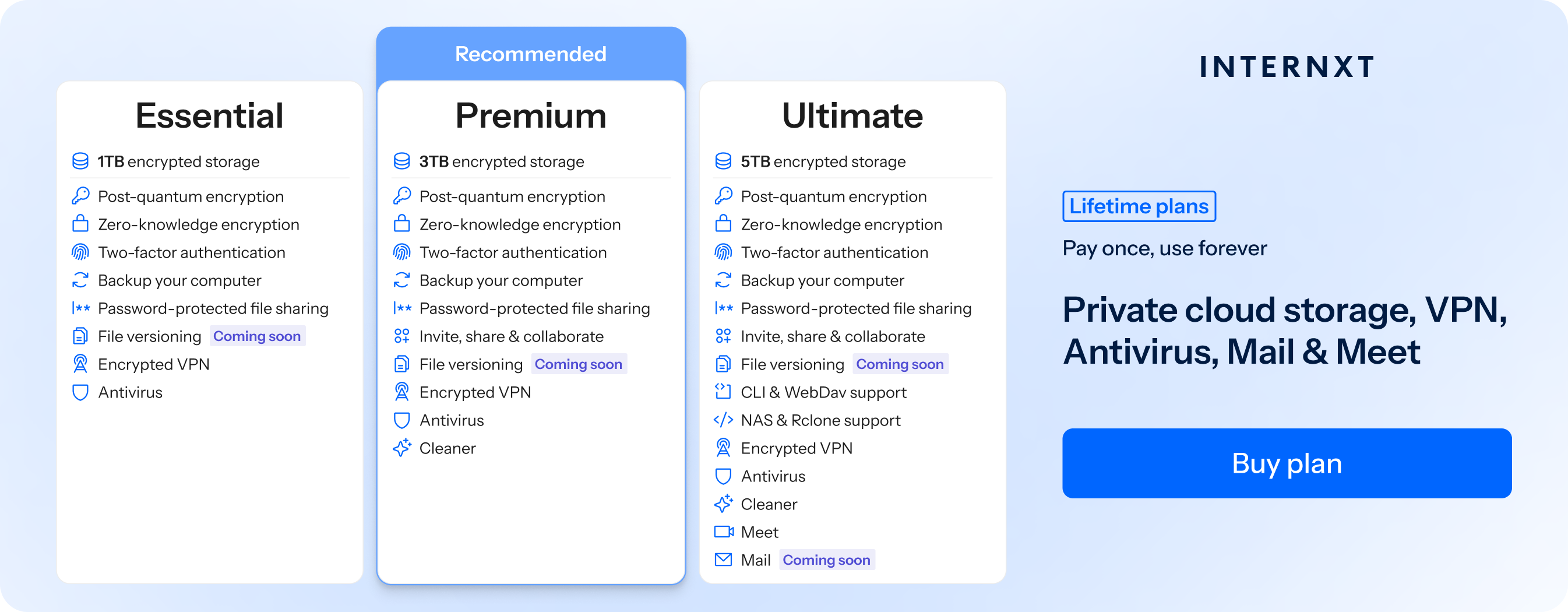
For annual and lifetime pricing, you can visit our website or check out the features of all Internxt plans below.
| Plan | Storage | Features | Annual Cost | Lifetime Cost |
|---|---|---|---|---|
| Essential | 1TB |
|
€18 | €285 |
| Premium | 3TB |
|
€36 | €435 |
| Ultimate | 5TB |
|
€54 | €585 |
Aside from this, Internxt ensures online privacy is accessible for everyone, so it offers the following free tools to help you get started in protecting with a secure online experience.
Get started with Internxt today for free, or join from just €2.00/month and make switching to privacy easy, affordable, and convenient.
Related articles
Did your password leak online?
Frequently asked questions
What is online privacy, and how to protect it?
Online privacy is the protection of your personal information, activities, and communications on the internet from being tracked, collected, or misused by others.
Why is online privacy important?
Taking measures to protect your online privacy is important because it prevents unauthorized access to your data, companies from creating profiles on how you use its services, and keeps your confidential information secure against data breaches, data loss, or cyberattacks.
What kind of information is at risk online?
Emails, first and last names, addresses, phone numbers, IP addresses, passwords, and social media posts are all at risk if you don’t take action to protect your online activities.
What are common threats to online privacy?
Common threats include data breaches, hackers, unsecured websites, tracking by advertisers, social media data collection, AI profiling, and outdated software vulnerabilities.
How can I protect my online privacy?
You can protect your privacy by using strong passwords, enabling two-factor authentication, updating software, using secure connections, limiting personal information shared online, and using privacy-focused tools, such as zero-knowledge cloud storage, VPNs, and secure browsers.