
The Best Open Source Object Storage Alternatives to AWS & more

Open source cloud storage offers greater transparency and peace of mind that your data is stored safely, as the code that builds that platform is available for everybody to view and verify its security and data handling.
With compatibility for popular APIs like Amazon S3, these 7 object storage solutions can handle a wide range of workloads, from backups and archives to data lakes and AI applications, while remaining scalable and cost-effective.
Table of contents
- What is S3 open source object storage?
- Why choose open source object storage
- The 7 best open source object storage providers
- Which open source object storage should you choose?
- Related articles
- Frequently asked questions
What is S3 open source object storage?
S3 open source object storage is a type of cloud storage that implements the same application programming interface (API) as Amazon S3.
With S3 object storage, you can store and manage data as objects, including files, backups, and media. It can be used to host user uploads, serve static content, and archive logs or records for long-term retention.
You can also use it for analytics and machine learning workloads, as many tools can read and write directly to S3 storage.
Object storage is therefore a useful solution for medium to large-sized businesses or enterprises, as it allows for rapid access to objects because each object is stored with a unique identifier and metadata.
As a result, the system can retrieve data directly without needing to navigate a traditional file hierarchy, enabling faster, more scalable access even as the amount of data grows.
Why choose open source object storage
The main object storage providers, AWS, Azure, and Google Cloud, run on proprietary software, meaning the code used to build their software is not open source and, therefore, not available for the public to view.
With open source object storage, however, everything is open source, meaning you can view the source code online and see how the software is built. Open source offers many advantages over proprietary solutions, which we will cover below.
Data control and privacy
All open source software apps make their source code publicly available, allowing anyone to verify how data is handled and ensure there are no hidden backdoors.
Organizations and security researchers can actively inspect the code for vulnerabilities, confirm that encryption and access controls are implemented correctly, and validate that privacy standards are being met.
Overall, this increased transparency gives businesses confidence that their sensitive data and the data of their customers are managed securely and in accordance with regulations.
Community support
Open source object storage is backed by active communities that continuously contribute updates, features, security patches, or create bug reports for investigation.
This ensures that S3 open source providers benefit from rapid innovation to keep up with advances in technology, implement security updates in a timely fashion, and remain sustainable in the long term.
Increased compatibility
Many open source solutions implement standard APIs such as S3, making them compatible with a wide range of existing tools and applications.
This allows organizations to leverage the same workflows, automation, and integrations that were originally built for cloud-based object storage, such as automated backup solutions, data lifecycle management tools, analytics, and data processing frameworks.
Security
Open source object storage offers strong security advantages because the source code is publicly available for inspection. This transparency allows developers, security researchers, and internal teams to identify bugs, vulnerabilities, or misconfigurations quickly.
Regular community contributions and updates from security experts or developers help patch issues faster than in closed-source systems, making open source solutions more resilient and trustworthy for storing sensitive or critical data.
The 7 best open source object storage providers
Below are 7 open source object storage providers for large-scale storage, hot or cold storage, or to focus on backing up files and data recovery.
Internxt S3
Internxt cloud object storage is a European and open-source object storage solution designed for fast access to data and to help businesses and enterprises store large amounts of data efficiently.
Unlike AWS or other grand object storage providers, Internxt does not charge for moving data in or out of the cloud (egress or ingress fees). Instead, you only pay for the storage you use, which with Internxt costs €7/TB/month.
Compared to the major cloud providers, Internxt costs ~ €0.007 per GB, compared to:
• AWS S3 Standard: ~ €20–€23 / TB ≈ €0.020–0.023/GB
• Azure Blob Hot: ~ €18–€20 / TB ≈ €0.018–0.020/GB
• Google Cloud Standard: ~ €20 / TB ≈ €0.020/GB
So the percentage you could save by migrating to the cloud with Internxt is as follows for object storage only:
• vs AWS S3 Standard: ~70–65% less
• vs Azure Blob Hot: ~65–60% less
• vs Google Cloud Standard: ~65% less
The S3 pricing model is fully scalable, so whenever you need to reduce or add storage to your account, you can modify your storage to meet your needs allowing you to 100 TB, 1 petabyte, and more.
Aside from being open source and a European tech company compliant with GDPR, Internxt is also ISO 27001, HIPAA, and SOC 2 compliant, so your business can be confident that all forms of data are stored to the highest security standards.
Choose Internxt S3 for storing data lakes, backups, strong data durability and security, and affordability with no additional costs.
Internxt also offers Internxt Drive for personal cloud storage, which is also an open-source cloud storage solution designed with your privacy in mind.
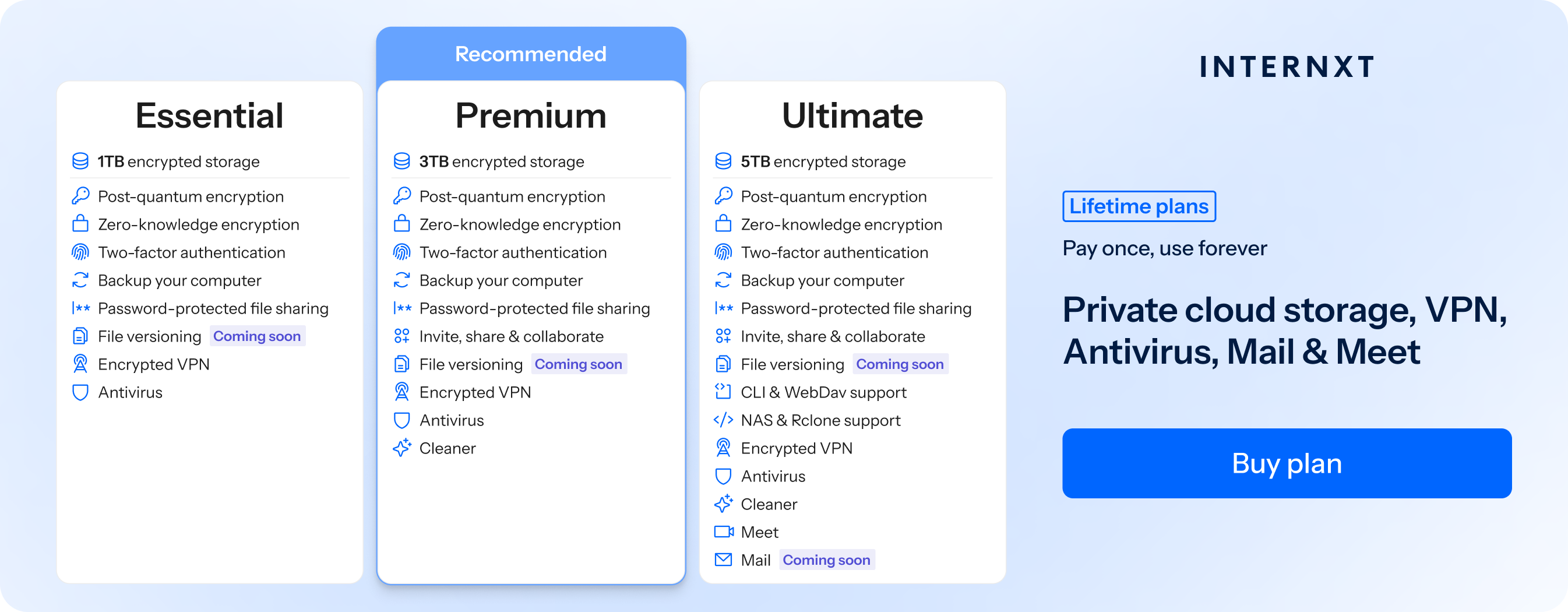
It offers annual (paid monthly) or lifetime plans, which you can find on our pricing page, where you can choose an Essential, Premium, or Ultimate plan to secure your files and privacy online.
MinIO
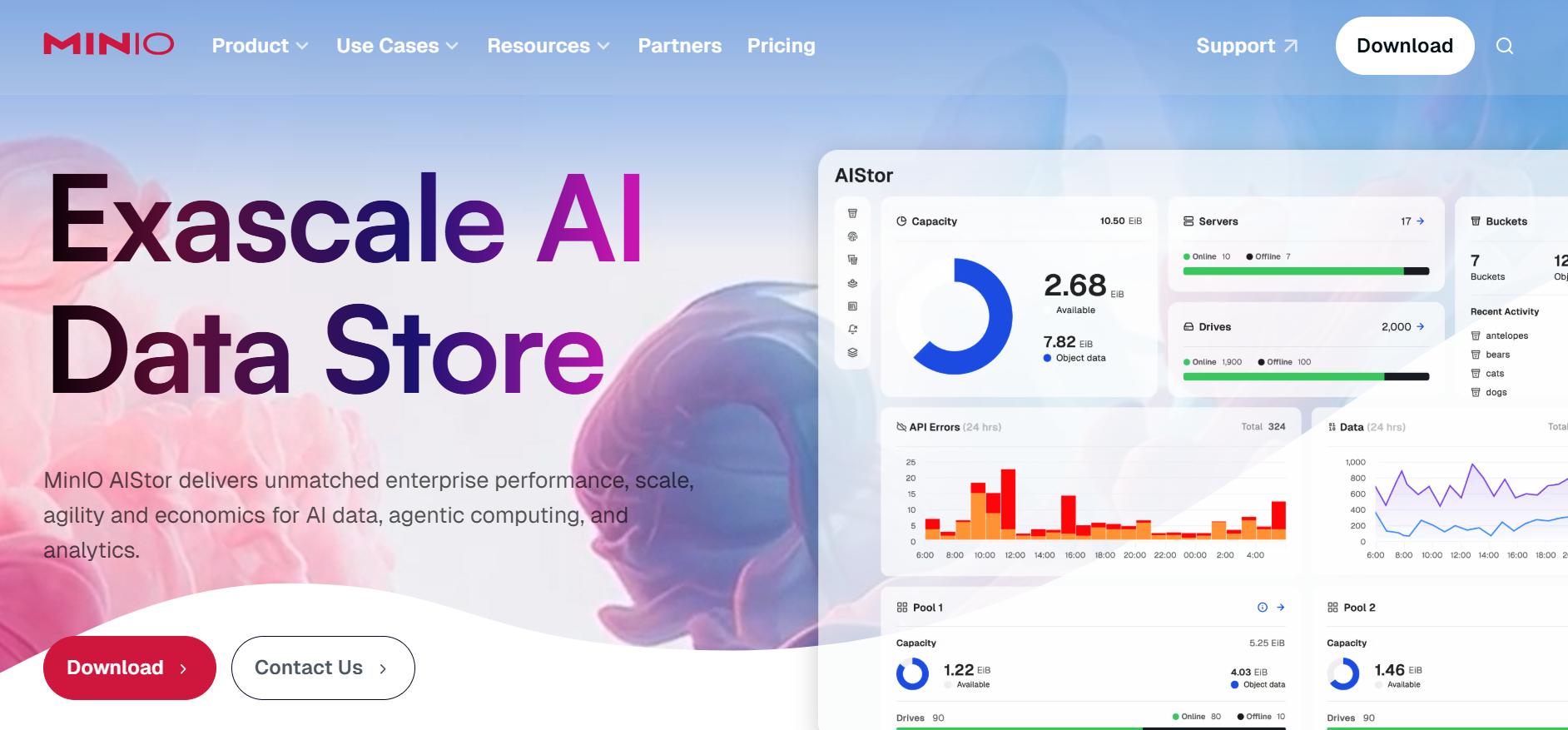
MinIO is a high-performance, S3-compatible object storage that is open-sourcedis ideal for AI/ML workloads, modern data lakes, and hybrid cloud environments.
MinIO is designed for cloud-native deployments and works consistently across these three cloud environments:
- Private: dedicated environments operated by a single organization, offering control and security
- Public: shared, off-site infrastructures provided by third-party companies
- Edge clouds: Edge clouds are distributed computing resources located closer to where data is generated or used, reducing latency and improving real-time performance.
MinIO is free to use if you self-host your object storage, and it also offers Enterprise Lite and Enterprise plans, for which you can request pricing plans from its website.
Choose MinIO when you want flexibility to deploy across private, public, or edge clouds with the option to self-host for free or scale with Enterprise support.
Ceph
Ceph offers an open-source storage platform that provides object, block, and file storage for multiple business use cases.
Ceph is commonly used by enterprises, cloud providers, and large IT organizations for private and hybrid cloud storage, virtualization, Kubernetes workloads, data lakes, analytics, and backups.
Ceph also uses algorithms for self-healing storage to identify and fix issues and redistribute and replicate affected data to healthy nodes without manual intervention.
Choose Ceph if you need a combination of object, block, or file storage and require secure backups for sensitive data through self-healing.
Storj
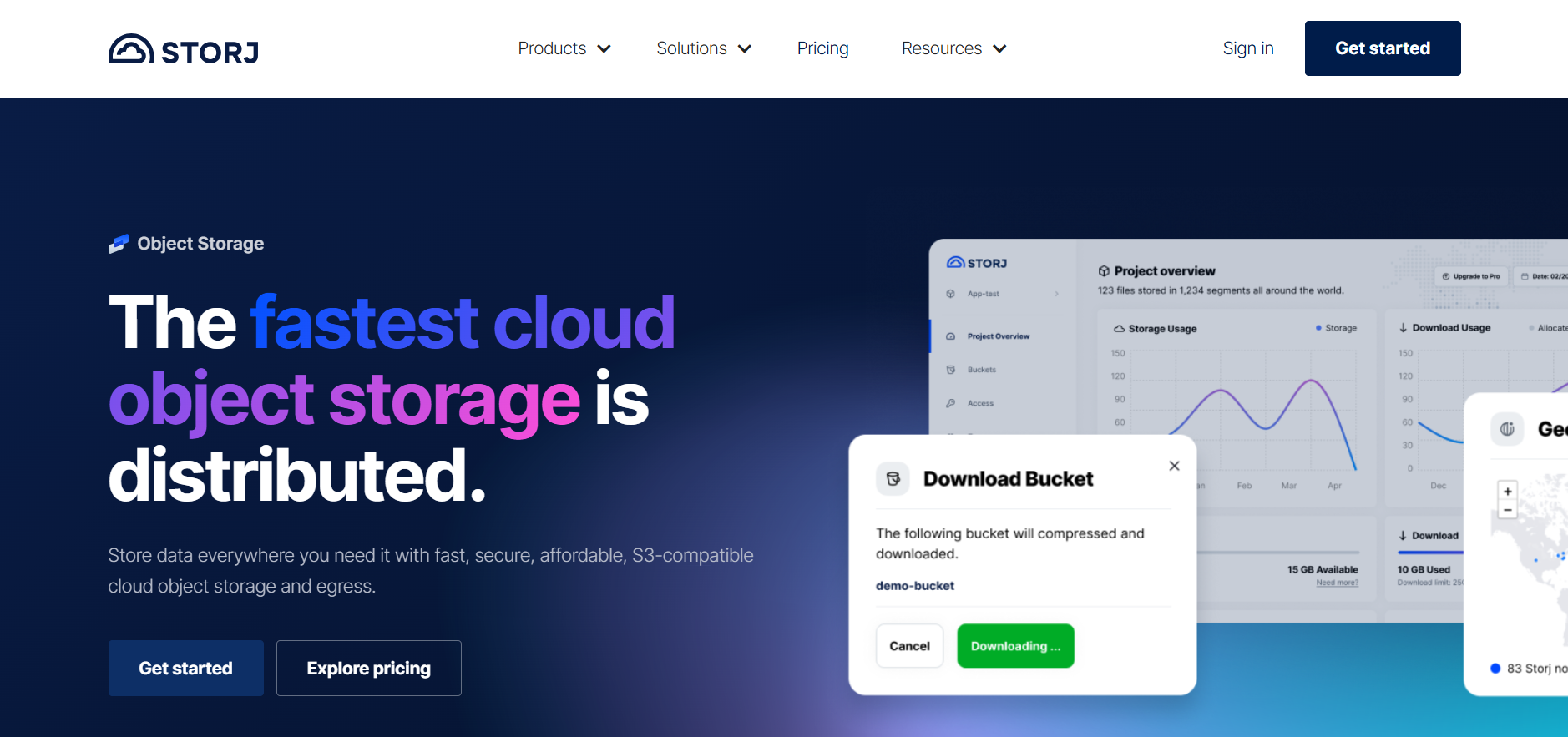
Storj improves critical business workloads by offering object storage that combines speed, security, and distributed architecture to meet modern enterprise storage needs for cold or data lake storage.
Storj also offers numerous plug-ins you can integrate into your object storage, including TrueNAS, Veeam, Varnish, Adobe, and many more.
Prices range from €6 to €15/TB/month, egress fees are included for Regional and Global plans, or $0.002/GB for the Archive plan.
Choose Storj if you want multiple integrations with other services in your object storage plan, or global distributed storage between the US and EU.
Garage
Garage is another open source object storage focused on users who wish to self-host their storage. With it, you can host websites, store media files, or back up important files. It implements the Amazon S3 protocol and thus is compatible with many applications, such as Nextcloud or CyberDuck.
Choose this S3-compatible object storage if you have knowledge of self-hosting, but the docs and steps to do so are available from their website.
Odilon
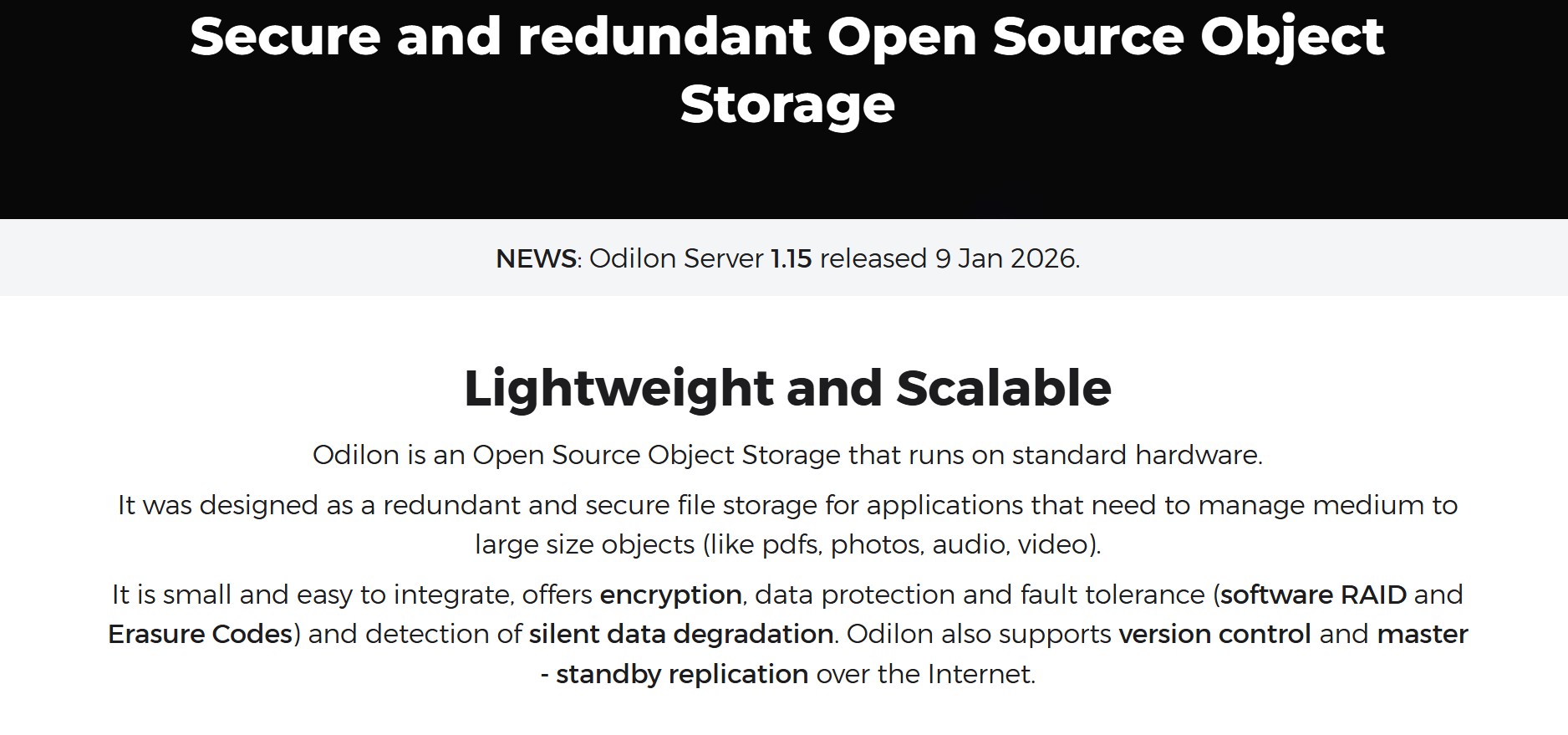
Odilon was designed as a redundant storage system for applications that need to manage medium to large-sized objects, such as PDFs, photos, audio, or videos. It has a simple single-level folder structure similar to the Bucket/Object model of Amazon S3 and offers version control and data immutability.
Odilon is therefore perfect for small to medium businesses that need a simple, secure, and reliable object storage solution without relying on large-scale distributed systems or cloud providers.
Which open source object storage should you choose?
For the closest object storage solution to Amazon, Microsoft, or Google, Internxt S3 offers the same reliable object storage plan for your company to host its data lakes in an efficient and affordable manner.
It offers redundancy of your files to protect against data loss, advanced encryption, and multiple compliance. To get started, you can contact the Internxt sales team from our website to see how it meets your business storage needs.
For more advanced features, you may wish to consider the big tech companies such as AWS, due to the multiple integrations with other apps and AI capabilities.
For self-hosted cloud storage, Odilon is a good alternative for developers who want to connect their storage to other apps. For block storage, Ceph is a versatile platform to meet your business needs.
Related articles
- Block vs object storage
- Enterprise cloud storage solutions
- 7 most efficient object storage products
- Cloud data migration
Frequently asked questions
What is the best open-source object storage?
Internxt S3 is the best S3 open source object storage, as it offers a similar service to the major object storage providers, with a more sustainable and efficient pricing model with no extra fees.
Who should use open-source object storage?
It is ideal for medium to large businesses, developers, IT teams, and organizations that need secure, scalable storage, want control over their data, and may prefer self-hosted or GDPR-compliant solutions.
Is open-source object storage secure?
Yes. Open-source storage offers encryption, versioning, and immutability. Community review and frequent updates make it easier to identify and fix vulnerabilities, making it safe for sensitive or critical data.