Amazon Drive vs Dropbox: What to Use Now That Amazon Drive Has Shut Down

Is it even worth talking about Amazon Drive in 2026? Not really, on its own, because the service no longer exists. Yet thousands of people still type "Amazon Drive vs Dropbox" into Google every month, unsure where their files are supposed to live now.
Amazon Drive shut down for good on December 31, 2023, and Amazon moved everything to Amazon Photos, which only keeps images. So your files need a new home.
If you want privacy, Internxt Drive encrypts everything so only you can read it. If you want easy syncing and sharing, Dropbox does that well. Google Drive and OneDrive work if you already live in those worlds, and there's a cheaper S3 option for developers further down.
If you came to pit Amazon Drive against Dropbox, we still do that below. But with Drive gone, the bigger question is which service to move to, and that's what most of this guide covers. Amazon has clearly moved on as well, giving Amazon Photos a major AI-powered redesign in May 2026 while leaving Drive behind.
Table of contents
- Is Amazon Drive still available?
- Why did Amazon discontinue Amazon Drive?
- What happened to my files when Amazon Drive shut down?
- Is Amazon Drive free for Prime members?
- Amazon Drive alternatives compared: which should you migrate to?
- Amazon Drive vs Dropbox: how did they compare?
- Why is Amazon S3 more expensive than Dropbox?
- Where Dropbox still falls short
- The private alternative: how Internxt compares
- Which should you choose now?
- FAQ
Is Amazon Drive still available?
No. Amazon Drive is gone, and it went in stages:
- October 31, 2022: the Amazon Drive app was pulled from the App Store and Google Play.
- January 31, 2023: Amazon stopped letting users upload new files.
- December 31, 2023: the service shut down for good. After that date you could no longer view or download files through Amazon Drive.
Photos and videos were moved over to Amazon Photos, which is still running. Everything else, meaning your documents, PDFs, zip files, and anything that wasn't an image or video, had to be downloaded by hand before the deadline, or it was gone.
Why did Amazon discontinue Amazon Drive?
Amazon's official reason was focus.
It would rather pour everything into Amazon Photos than keep two overlapping storage products limping along. And honestly, Drive was always the neglected sibling: confusingly branded (it spent years as "Amazon Cloud Drive"), thin on features, and buried so deep in Amazon's menus that most people never knew it was there.
It's a small thing, but it matters. Amazon Drive didn't fail, exactly. It just stopped earning its place inside a company with bigger bets elsewhere. When you hand your files to Big Tech, you're trusting that the product stays profitable enough to keep around, and that call gets made in a boardroom, not by you.
What happened to my files when Amazon Drive shut down?
If you stored photos or videos, they were moved to Amazon Photos automatically, and they're still there.
The downside is that Amazon Photos only takes images and videos, not the documents and general files Drive used to hold. (If you'd rather not leave your photos with Amazon either, here's our take on the best Amazon Photos alternatives.)
Anything else, you had to download before December 31, 2023, because none of it was migrated. If you're only finding out about the shutdown now, whatever non-media files you kept on Amazon Drive are no longer recoverable from Amazon.
Either way, you'll need somewhere new to put your files.
Is Amazon Drive free for Prime members?
This one trips people up, so let's be precise. Amazon Photos, which is still running, gives Prime members unlimited photo storage and 5GB for videos as part of the membership. Amazon Drive, which is gone, used to have its own separate 5GB free tier with paid plans on top.
So if what you're really asking is "do I still get free Amazon storage with Prime?", the answer is yes, but only for photos and videos, through Amazon Photos. For documents and general files, Prime now gives you nothing.
Amazon Drive alternatives compared: which should you migrate to?
Here's how the main consumer options stack up. Amazon Drive is in the table only as a reference point, since you can't actually sign up for it anymore.
| Amazon Drive | Internxt | Dropbox | Google Drive | OneDrive | |
|---|---|---|---|---|---|
| Status | Discontinued (2023) | Active | Active | Active | Active |
| Free storage | N/A | 1GB | 2GB | 15GB | 5GB |
| Entry paid plan | N/A | 1TB: from €1.99/mo (billed annually) or €379.99 lifetime | 2TB: $9.99/mo (billed yearly) | 2TB: $9.99/mo ($119.88/yr) | 1TB: $9.99/mo with M365 Personal ($99.99/yr) |
| Lifetime option | N/A | Yes (1TB €379.99 one-time) | No | No | No |
| Zero-knowledge encryption | No | Yes (AES-256 + post-quantum) | No (AES-256, not zero-knowledge) | No | No |
| Jurisdiction | US | EU (Spain), GDPR | US | US | US |
| Open source / audited | No | Yes (Securitum-audited) | No | No | No |
| Best for | N/A | Privacy-first individuals | Collaboration and syncing | Google ecosystem | Microsoft ecosystem |
Internxt's annual plans are billed yearly, and the €1.99/mo (1TB) rate is a current promotional price (80% off the €9.99/mo standard rate). A one-time lifetime plan (€379.99 for 1TB) is also available. Google One 2TB and Microsoft 365 Personal (1TB) are the closest comparable paid tiers, and both also offer 100GB plans at $1.99/mo.
If you just want the easiest mainstream replacement with solid syncing and team features, Dropbox is the natural pick. If part of why you're leaving Amazon is that you'd rather not hand your files to another US data giant, Internxt is built around exactly that worry.
For a wider look at the field, see our full guide to the best Dropbox alternatives, or the head-to-heads on Dropbox vs OneDrive and Box vs Dropbox.
Amazon Drive vs Dropbox: how did they compare?
If you specifically came for the head-to-head, here it is, with the obvious asterisk that one of the two is no longer breathing.
Amazon Drive was cheap and plugged into the Amazon ecosystem, and that was about the end of its charm.
It was barebones: clumsy sharing, no real sync, and hardly any collaboration tools. Dropbox is the opposite. Sync and sharing are the whole point; it works smoothly across every device, and it has shared folders, version history, and file requests that Amazon Drive never bothered to build.
On price, Dropbox Plus runs $9.99 a month (billed yearly) for 2TB and a single user. That's more than Amazon Drive used to charge, but you're paying for something that's actively maintained and genuinely good at its job. (We break down all the tiers in our Dropbox pricing guide.)
Not everyone typing that comparison was looking for somewhere to keep holiday photos, though. A fair number of people mix up Amazon Drive with Amazon S3, Amazon's storage built for developers, and get stuck on a strange question: why does 1TB on S3 cost about $276 a year when Dropbox sells 2TB for $120?
Why is Amazon S3 more expensive than Dropbox? (and the cheaper S3 alternative)
It looks backwards until you realise S3 and Dropbox aren't the same kind of product at all.
Amazon S3 is raw infrastructure. You pay per gigabyte stored, plus per API request, plus egress fees every time you pull data out. It's priced for developers building applications, where that granular billing makes sense. Dropbox is a finished consumer product with flat, bundled pricing, and it runs at enormous scale.
In fact, Dropbox moved the bulk of its storage off Amazon S3 onto its own infrastructure, "Magic Pocket," back in 2015 and 2016, shifting more than 500 petabytes of user data and cutting operating costs by tens of millions a year. So Dropbox isn't reselling S3 at a markup. It's running its own, cheaper stack.
The real sting with S3 is those egress fees. Pulling data out can quietly dwarf your storage bill, something we get into in our breakdown of Amazon S3 storage costs. That's exactly where an S3-compatible alternative earns its keep:
| 1TB stored for one year | Amazon S3 Standard | Internxt Object Storage |
|---|---|---|
| Storage | ~$276/yr (~$0.023/GB/mo) | €84/yr (€7/TB/mo) |
| Ingress / egress fees | Charged per GB | €0 |
| S3 / IAM API compatible | Yes | Yes |
| Encryption | Server-side | Server-side (SSE-C) |
Internxt's S3-compatible object storage is an alternative to AWS for storage and charges zero ingress or egress fees, while staying compatible with the S3 tooling you already use. For predictable bills on real workloads like media archives, backups, and data retention, that gap adds up fast.
Where Dropbox still falls short
Back on the consumer side, Dropbox is a polished product, and for collaboration it's hard to fault. But it has two real weaknesses worth being clear about.
The first is privacy.
Dropbox encrypts your files with 256-bit AES and protects them in transit with SSL/TLS, but it isn't zero-knowledge. Dropbox holds the keys, which means Dropbox and anyone who can legally compel Dropbox, can technically get at your files.
End-to-end encryption only shows up on its top-tier Advanced business plan. For most people, that means your files are private from other users, but not private from Dropbox itself.
The second is jurisdiction. Dropbox is a US company under US data law. If part of why you left Amazon was unease about how Big Tech handles data, moving to another big US provider doesn't really fix that.
None of this is a dealbreaker for everyone. If you just want files that sync and a team that can work together, Dropbox is great. But if privacy was ever the point, it's worth looking at something built for it.
The private alternative: how Internxt compares
Internxt is a privacy-first cloud storage company based in Valencia, Spain, and the whole product is built around one stubborn idea: your files should be readable by you and nobody else, us included.
Here's what that means in practice. Your files are encrypted on your device before they ever leave it, using zero-knowledge AES-256 encryption with post-quantum protection.
Internxt also splits each file into encrypted shards, so no server ever holds a whole file. We don't store your password, and we genuinely can't read your data. The code is open source on GitHub, and the service has been independently audited by Securitum, one of Europe's leading penetration-testing firms.
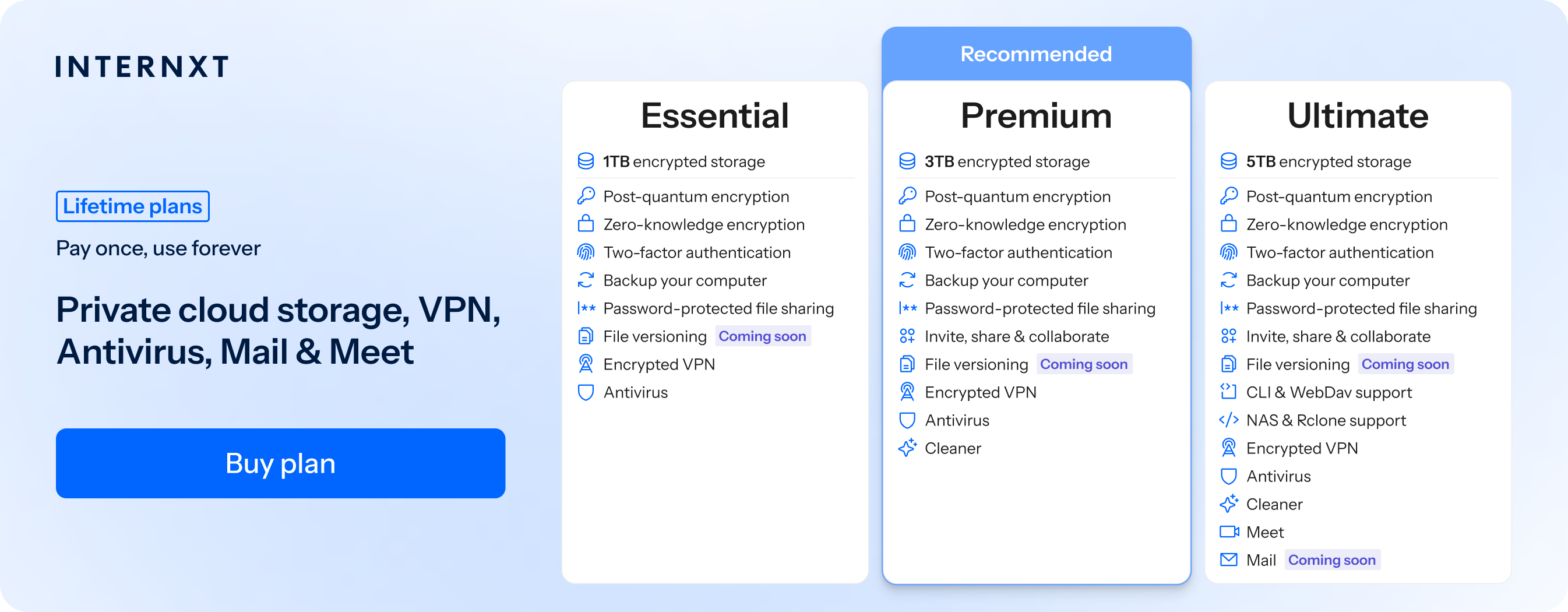
On the practical side, there's a free plan with 1GB, and paid plans at 1TB, 3TB, and 5TB starting from €1.99 a month (billed annually, on a current promotion).
Internxt also does something almost no mainstream rival offers: lifetime plans, where a single one-time payment (1TB for €379.99, up to 5TB) keeps your storage for good. Being EU-based, it's fully GDPR-compliant, with HIPAA, ISO 27001, and SOC 2 compliance on top.

FAQ
Why did Amazon discontinue Amazon Drive?
Amazon shut down Amazon Drive on December 31, 2023 to focus on Amazon Photos instead of maintaining two overlapping storage products. Photos and videos were migrated to Amazon Photos, while other file types had to be downloaded before the deadline or were lost.
Which is better, Amazon Drive or Dropbox?
Amazon Drive no longer exists, so Dropbox wins by default between the two. When both were running, Dropbox was far stronger for syncing, sharing, and collaboration, while Amazon Drive was cheaper but barebones. For privacy specifically, neither is zero-knowledge, so Internxt is the better pick.
Is Amazon Drive free for Prime members?
Not anymore. Amazon Photos still gives Prime members unlimited photo storage and 5GB for videos, but Amazon Drive, which had its own 5GB free tier for general files, was shut down at the end of 2023.
Where should I migrate from Amazon Drive?
For privacy, Internxt (zero-knowledge, EU-based, lifetime plans). For mainstream syncing and collaboration, Dropbox. For Google or Microsoft users, Google Drive or OneDrive. For developers needing object storage, Internxt's S3-compatible storage.
Why is Amazon S3 more expensive than Dropbox?
Amazon S3 is raw developer infrastructure billed per gigabyte plus request and egress fees, while Dropbox is a flat-rate consumer product running its own large-scale infrastructure.
They serve different needs. For cheaper S3-compatible storage, Internxt Object Storage costs about 80% less than AWS with no egress fees.
Is Dropbox zero-knowledge?
No. Dropbox uses 256-bit AES encryption and SSL/TLS in transit, but it holds the encryption keys, so it is not zero-knowledge. End-to-end encryption is only available on its top-tier Advanced business plan. Internxt is zero-knowledge by default on every plan.
Which should you choose now?
So which one should you actually pick? It depends on what you care about most.
- If privacy matters most, go with Internxt: zero-knowledge encryption, EU jurisdiction, open source, and a lifetime option so you're never at the mercy of a subscription, or another shutdown.
- If you want the smoothest mainstream sync and collaboration, Dropbox is the safe, polished choice, as long as you're fine with US jurisdiction and non-zero-knowledge encryption.
- If you already live in Google or Microsoft's world, Google Drive or OneDrive will be the easiest move.
- If you're a developer who needs S3 storage, Internxt Object Storage gives you S3 compatibility with no egress fees and a much lower storage bill.
Whatever you land on, remember what Amazon Drive made obvious. A tech giant can switch off a service whenever it suits them, and your files go with it. You're better off with a company that's genuinely built around protecting your data and plans to stick around.
Related tools