
A Beginner’s Guide to the Different Types of Encryption

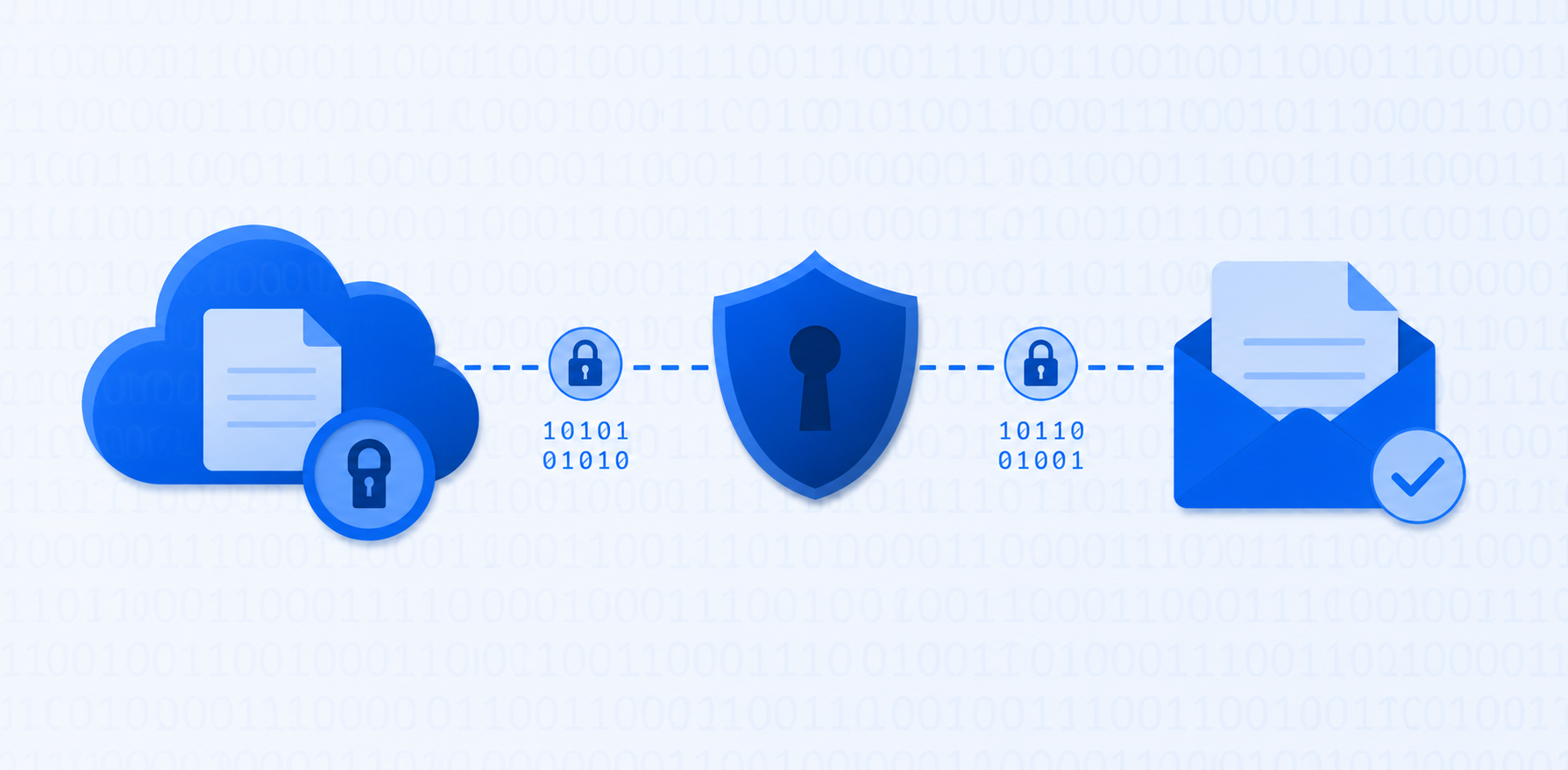
Data encryption turns plain text (readable data, like what you’re reading now) into ciphertext (unreadable data that looks like this:
8f3c9a72e1b4d6f08a5c21d9e7b3f6421cd48f39fj0ac2x
Data encryption protects our emails, shared files, cloud storage, and pretty much all the activities we do online from hackers, data breaches, and ransomware.
Companies use many types of encryption to protect data; while all offer the same levels of security, there are differences when it comes to the privacy of your data.
As a result, it’s important to choose the right encryption for your business and personal needs, which we’ll cover in detail throughout this article.
Table of contents
- What are the different types of encryption?
- The most common encryption methods
- Future types of encryption: post-quantum cryptography
- Types of encryption for privacy
- What types of encryption do cloud storage providers use?
- What are the best types of encryption?
- Related products
- Frequently asked questions
What are the different types of encryption?
There are two main types of data encryption: symmetric encryption and asymmetric encryption. Hashing often falls into this category as it is a cryptographic technique used to protect and verify files and store or share passwords securely.
Symmetric encryption
Symmetric encryption secures data using the same secret key to both encrypt and decrypt it.
You use this secret key to encrypt the file, and the same secret key is needed to decrypt it and view its contents. Without the secret key, you would only see the encrypted data.
Symmetric encryption techniques and algorithms include
- AES (Advanced Encryption Standard)
- ChaCha20
- Twofish
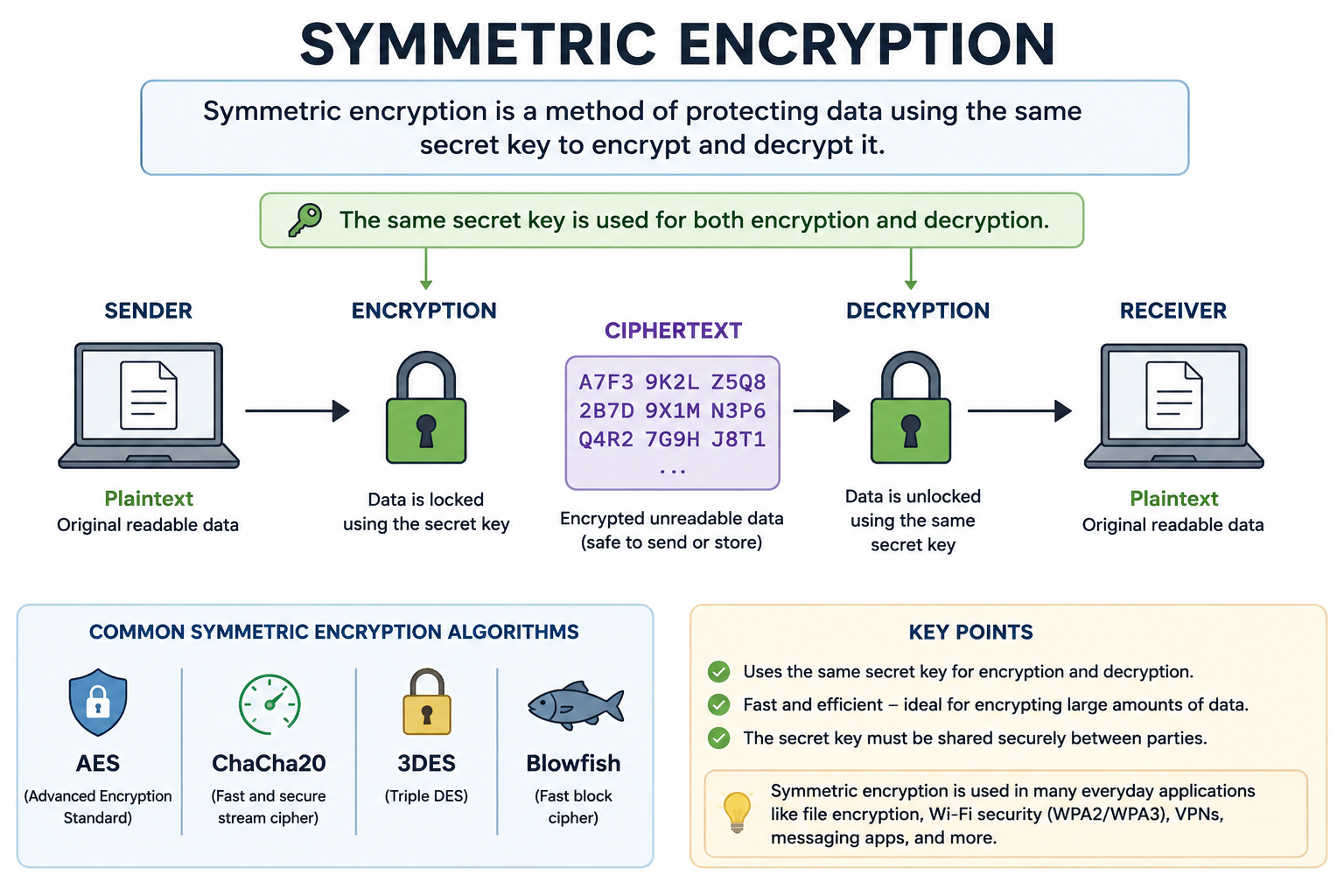
Symmetric encryption is used to encrypt files, databases, messages, and large amounts of data.
Asymmetric encryption
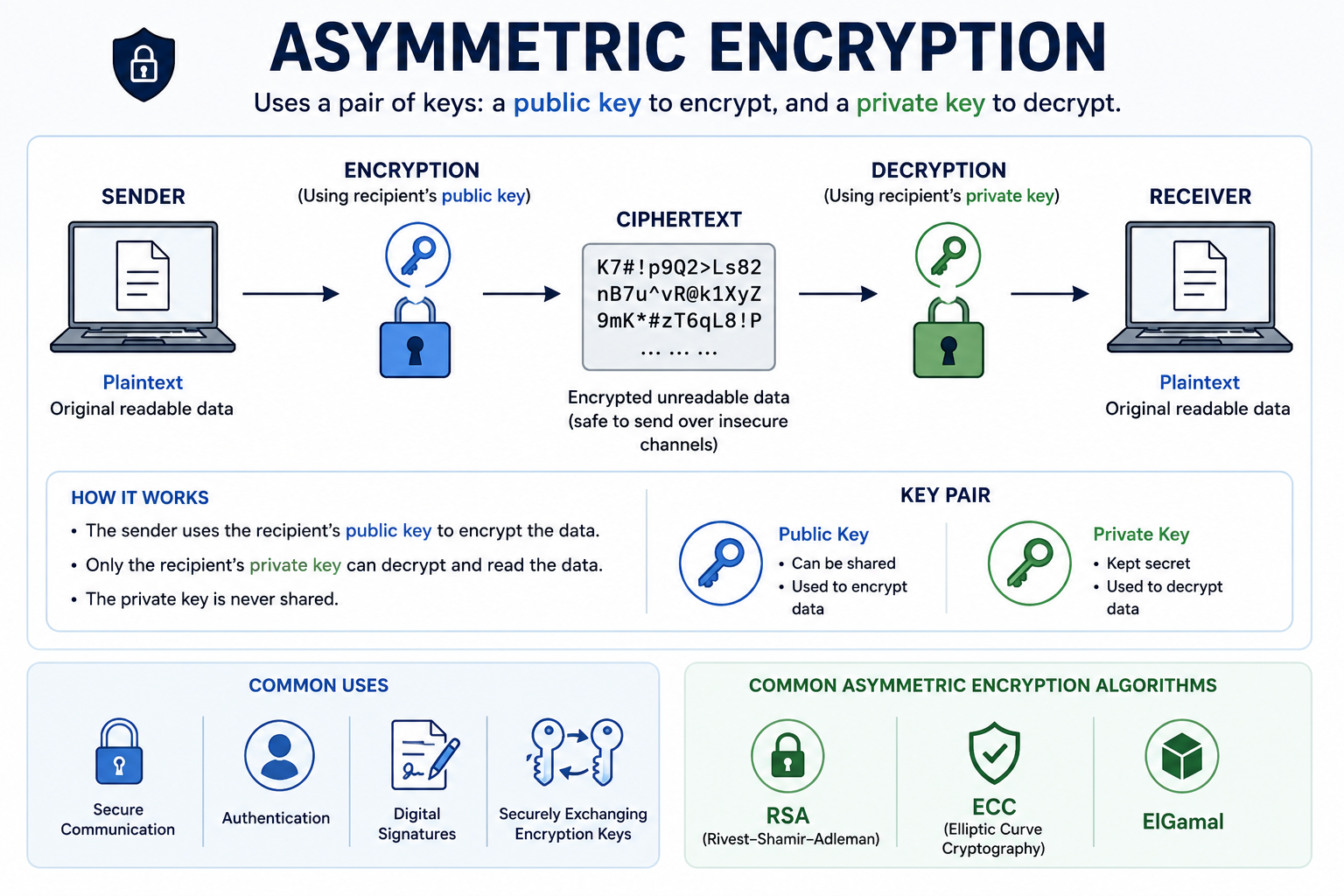
Asymmetric encryption is a type of public key cryptography and protects data using two keys: a
- Public key: Used to encrypt the message
- Private key: needed to access data encrypted by the public key
Asymmetric encryption algorithms include:
- RSA
- ECC (Elliptic Curve Cryptography)
Asymmetric encryption is commonly used for secure communication, authentication, digital signatures, and securely exchanging encryption keys.
How hashing works with encryption techniques
Hashing isn’t one of the types of encryption, but it is used with cryptography to store and retrieve data.
Hashing is used to protect your passwords by storing the hash instead of the password.
For example, imagine your password is %jM/[]#b2zxvb.
When you create an account, the system runs your password through a hashing algorithm, producing something like:
%jM/[]#b2zxvb → $2b$12$LQv3c1yqBW
When you log in, it hashes the password you enter and compares the new hash with the stored hash. If they match, you’re allowed in.
To prevent problems if people have the same password, a salt is added to a hash, which is a random value added to each password before hashing. Even though both users have the same password, their stored hashes will be different because their salts are different.
The most common encryption methods
Advanced Encryption Standard (AES)
The Advanced Encryption Standard (AES) is a symmetric encryption algorithm that is the most frequently used method of data encryption globally. It is widely used in cloud storage, including Google Drive, iCloud Drive, and Internxt, as it is the standard used to protect and encrypt data.
AES encrypts data in fixed 128-bit blocks and supports three key sizes:
- 128-bit
- 192-bit
- 256-bit
The key size determines how many encryption rounds are performed: AES-128 uses 10 rounds, AES-192 uses 12, and AES-256 uses 14.
The best encryption methods use AES-256 for maximum protection against brute-force attacks, which is why it is used for encrypted cloud storage, wi-fi security, VPNs, and more.
Rivest Shamir Adleman (RSA)
The Rivest Shamir Adleman algorithm is an asymmetric form of encryption. It relies on the difficulty of factoring very large prime numbers, making it computationally difficult to derive the private key from the public key.
RSA is commonly used for digital signatures, authentication, and securely exchanging encryption keys.
Twofish
Twofish is a symmetric encryption algorithm that encrypts data in 128-bit blocks and supports key sizes of up to 256 bits. It was one of the finalists in the competition that selected AES, so it is well-known for its security and can be used for file and folder encryption.
Elliptic Curve Cryptography (ECC)
Elliptic Curve Cryptography (ECC) is a public-key cryptographic method that uses mathematical calculations involving points on a specific type of curve. Its security relies on the difficulty of determining a private key from a public key and is an encryption method used by Proton Drive.
ECC can provide the same level of security as RSA while using much smaller keys. For example, a 256-bit ECC key can provide security comparable to a much larger RSA key.
Future types of encryption: post-quantum cryptography
By 2035, the National Institute of Standards and Technology recommends companies change to post-quantum encryption to protect against the future threats of quantum computing, which could break modern types of encryption and cause major data breaches.
Lattice-based cryptography
Lattice-based cryptography is a leading approach to post-quantum cryptography.
It is based on mathematical problems involving points arranged in high-dimensional structures called lattices. These problems are believed to be extremely difficult to solve efficiently, even for quantum computers.
ML-KEM-512, ML-KEM-768, and ML-KEM-1024 (formerly known as Kyber) are the main types of encryption used in this cryptography to protect files using these new encryption methods.
Internxt Drive is the first cloud storage to have post-quantum encryption, using a combination of ML-KEM 512 and AES 256 end-to-end encryption to protect your files against current and future cybersecurity threats and big tech surveillance.
Types of encryption for privacy
Now we know the different types of encryption; as we mentioned at the beginning of this article, these encryption methods are highly secure, but not necessarily private.
Below you can see why.
In transit and at rest encryption
In transit encryption encrypts files or data while it’s sent over the internet; at rest encryption keeps data encrypted on servers.
Google Drive encryption, and its suite of products like Gmail, as well as other big tech companies, use it to secure your files.
However, your files and data are not encrypted on your devices; the keys are managed by the companies, so any files stored on their service can be decrypted and viewed by employees.
So while this kind of encryption is secure, it’s not guaranteed if you want total privacy.
End-to-end encryption
End-to-end encryption, or zero-knowledge encryption, encrypts files directly on your device, meaning you manage the encryption keys.
This means nobody but you, or those you share files or send emails to, can access your private documents, emails, or folders.
Internxt Drive uses post-quantum end-to-end encrypted cloud storage to give you maximum privacy and an alternative to Google Drive, so nobody but you can view your files.
What types of encryption do cloud storage providers use?
Internxt Drive
Internxt Drive is the only provider thus far to use post-quantum encryption combined with the current gold standard AES-256 encryption.
All Internxt pricing plans benefit from this kind of encryption, and it is also used in Internxt’s file sharing features for Drive and Internxt Send to send files securely online.
Aside from Drive, Internxt uses its zero-knowledge encryption methods across its product suite: Internxt Mail, Meet, and the best alternative to Google Photos, Internxt Photos.
So with Internxt, you get the best encrypted and private cloud storage, as everything is encrypted on your device, giving you full control and zero access of your files by anybody but you.
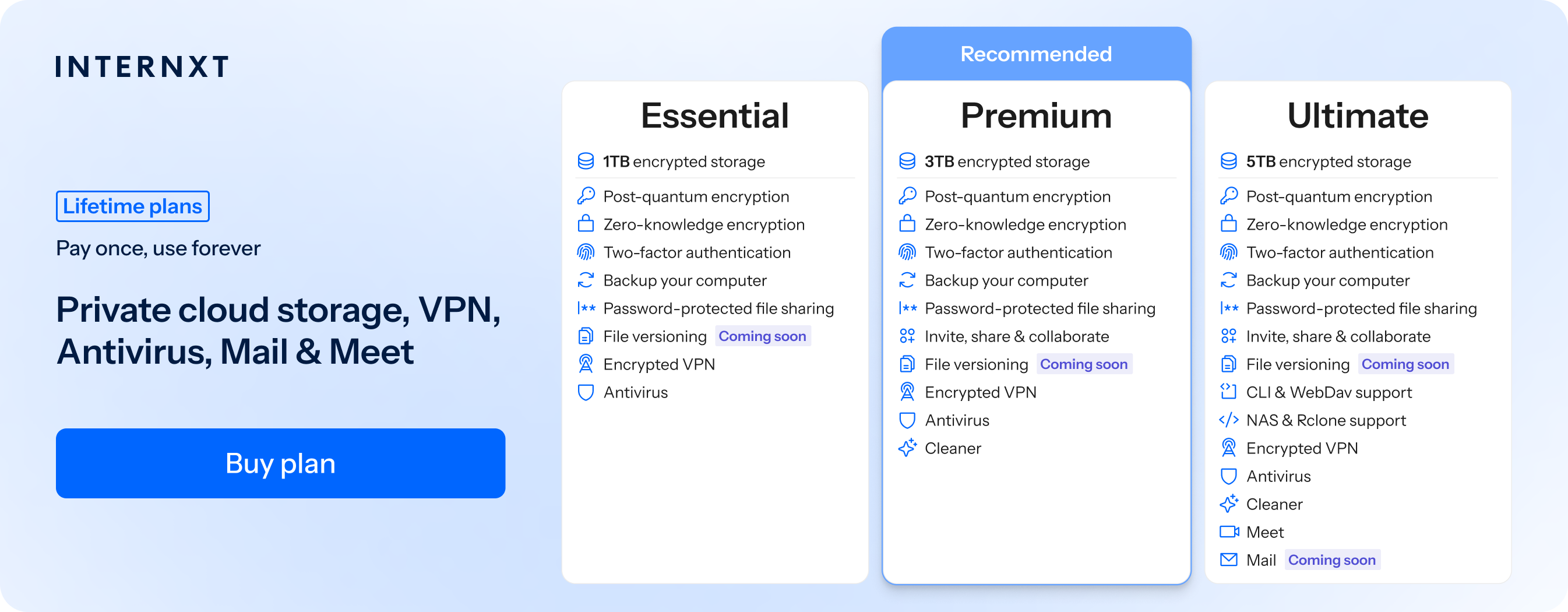
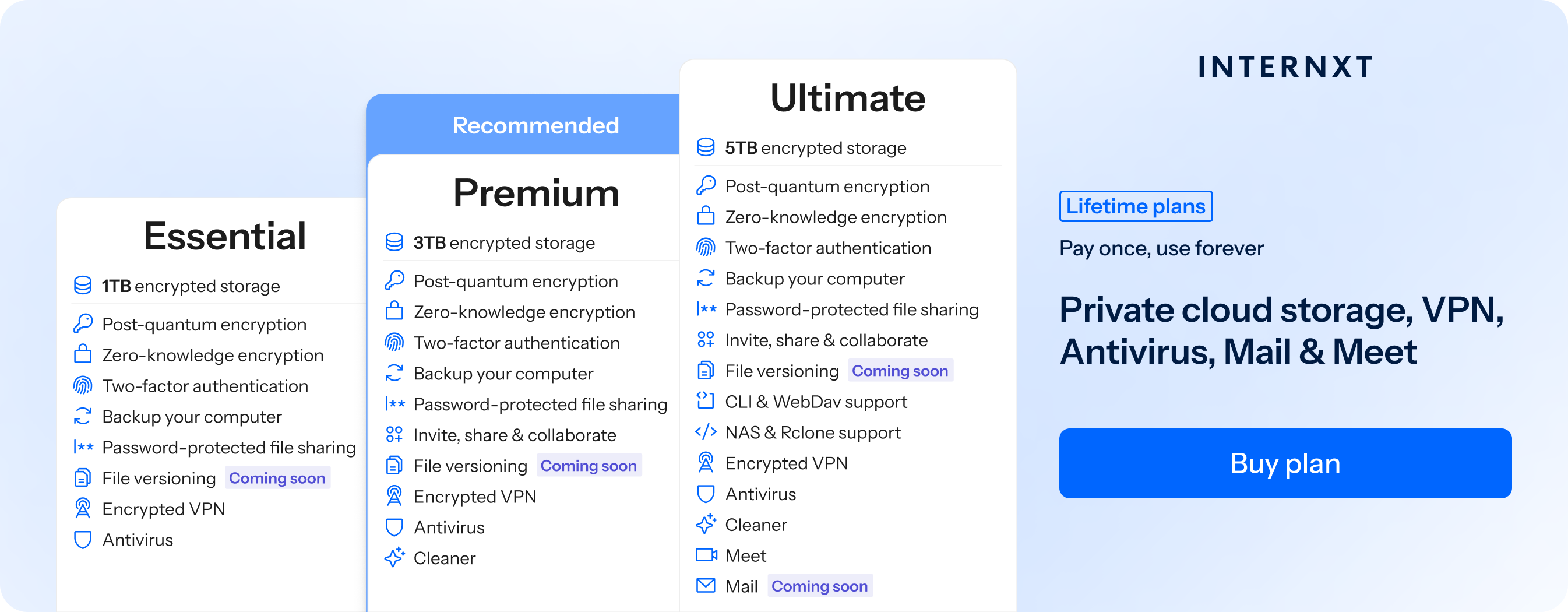
Get started with post-quantum encrypted cloud storage for free with Internxt, or get 85% off all plans, which include the features below.
| Plan | Storage | Features | Annual (Paid monthly) | Lifetime Cost |
|---|---|---|---|---|
| Essential | 1TB | €1.99/month | €380 | |
| Premium | 3TB |
|
€3.99/month | €580 |
| Ultimate | 5TB |
|
€5.99/month | €780 |
| *Prices are correct at the time of writing and are subject to change. For latest prices, check https://internxt.com/pricing | ||||
Google Drive, OneDrive, Dropbox
Google Drive, OneDrive, Dropbox, and many cloud providers use AES-256 encryption for files both at rest and in transit.
Dropbox also offers advanced encryption and key management for certain business plans, but standard Dropbox security does not provide client-side encryption by default.
So while your files are protected on the provider’s servers, it doesn’t automatically mean they cannot access the decrypted content.
Icedrive & pCloud
Icedrive uses Twofish with a 256-bit key for its client-side encryption, but only for its paid plans, so free plans are not end-to-end encrypted.
pCloud uses AES-256 encryption, but end-to-end encryption is only available on top of pCloud’s pricing plans with pCloud Crypto, so you have to pay more for privacy, or risk pCloud viewing your files.
If you’re wondering is pCloud safe without pCloud vault, there are reports online of lifetime cloud storage plans being deleted for violating pCloud’s terms, suggesting they could access your files.
Proton Drive
Finally, Proton Drive uses end-to-end encryption combined with Elliptic Curve Cryptography to protect your files and keep them private, even from Proton.
Like Internxt Drive, it is one of the best alternatives to OneDrive and other big tech services to consider if you want to combine encrypted cloud storage with a full privacy suite of products like VPN, email, and Meet.
What are the best types of encryption?
For maximum privacy, end-to-end encryption for email, messaging, and cloud storage ensures the service provider does not have access to the keys needed to decrypt your data.
As technology advances, so does encryption, which is why it’s important to combine end-to-end encryption with new post-quantum cryptography; for this, Internxt is the best choice to protect your privacy online.
Encryption is only one part of the equation, however. No matter the security of different encryption techniques, you still need to take caution when protecting your accounts using secure passwords, 2FA, and backing up copies of your files in the cloud.
Related products
Frequently asked questions
What are the two main types of encryption?
The two main types are symmetric and asymmetric encryption. Symmetric encryption uses the same key to encrypt and decrypt data, while asymmetric encryption uses a public key and a private key
Is hashing a type of encryption?
No. Hashing is a separate cryptographic technique rather than a type of encryption. It is commonly used to protect passwords and verify data.
What is the best type of encryption for privacy?
For maximum privacy, end-to-end encryption is preferable because the service provider does not have access to the keys needed to decrypt your data. Combining end-to-end encryption with post-quantum cryptography can provide additional protection against future threats
Can encrypted data be hacked?
Strong encryption is extremely difficult to break through brute-force attacks, but encryption does not protect against every threat. Weak passwords, compromised accounts, stolen keys, or insecure systems can still expose data