
How to Ensure Reliability of Data in the Cloud

The reliability of data is crucial when managing files in the cloud, especially for businesses, enterprises, and even the data reliability of your own personal files.
In this article, we’ll cover everything about data reliability: what it is, why it’s important, assessing the reliability of data, and cloud storage solutions to keep your data protected, accurate, and complete.
Table of contents
- What is data reliability?
- Why data reliability is important
- What makes data reliable?
- Assessing the reliability of data
- How to ensure data reliability with Internxt
- Related products
- Frequently asked questions
What is data reliability?
Data reliability relates to how trustworthy data is when stored in the cloud and can be explained in three parts:
- Accuracy: Files uploaded to the cloud remain the same as when you saved them, without unexpected changes or errors.
- Completeness: Files and contents are stored in full, with no missing folders lost during the upload process.
- Consistency: When you access files across different devices, the data remains the same across all platforms without unexpected changes, differences, or conflicting versions.
Cloud storage providers help maintain data reliability through the following measures:
- Data redundancy: Data is stored in multiple cloud data centers to protect against data loss; if anything happens to one center, data is backed up in another location.
- Integrity checks: Detect corrupted files or unexpected changes.
- Backups: Allow data to be recovered in case of accidental deletion or system failure.
In short, data reliability means you can trust that the information you store in the cloud remains intact, complete, and consistent whenever you retrieve or use it.
Why data reliability is important
Data reliability matters because people and businesses depend on stored information to stay trustworthy over time. Without reliability of data, it can result in lost photos, damaged documents, missing business records, or incorrect information being used to make decisions.
Checking data reliability offers significant value for businesses, including:
- Greater efficiency: Organizations spend less time correcting or looking for data errors and more time using information productively.
- Better compliance: Reliable data helps organizations meet industry standards and fulfil legal and regulatory requirements such as GDPR, SOC 2, or ISO 27001.
- Improved risk management: Trustworthy data enables organizations to identify potential risks more accurately and take appropriate steps to reduce them.
When data is reliable, users can trust that their files have been preserved correctly and that the information they retrieve reflects what was originally stored or updated. This is particularly important for businesses that rely on accurate records, financial information, customer files, and operational data.
What makes data reliable?
Data reliability comes from the methods used to collect, transfer, store, verify, and maintain information. This depends on whether a provider’s cloud storage requirements can preserve data correctly despite hardware failures, software errors, interrupted uploads, or accidental deletion.
For example, when a file is updated, the storage system must ensure that the new version is saved properly and that interrupted operations do not leave it in an incomplete state. Version history and recovery mechanisms can help restore earlier versions after accidental changes or deletion.
Assessing the reliability of data
Assessing data reliability involves regularly evaluating whether information is trustworthy, accurate, complete, and suitable for its intended purpose. Businesses can do this by conducting regular data quality assessments, validation tools, performing statistical analysis, and conducting regular audits.
Several factors help determine how reliable data is:
- Accuracy: Whether the information correctly represents the real-world facts, events, or conditions it describes.
- Completeness: Whether all the necessary information is present, without missing values, records, or essential details that could affect the results.
- Consistency: Whether information agrees across different datasets, systems, and records, without unexplained contradictions or discrepancies.
- Validity: Whether data follows the required formats, rules, definitions, and acceptable ranges, ensuring it meets the requirements for its intended use.
- Uniqueness: Whether each record is represented appropriately, without unintended duplicates that could distort analysis or lead to incorrect conclusions.
For personal use, you can check the reliability of data in your cloud account by reviewing personal files and records for errors or missing information, verifying that saved files have not been corrupted, and ensuring that backups can be restored when needed.
How to ensure data reliability with Internxt
Internxt offers two types of cloud storage for data reliability in the cloud for personal, business, and enterprise use.
Internxt Drive
If you need reliability of data for cloud storage for personal use or small business needs, then Internxt Drive encrypted cloud storage is a secure and reliable cloud storage solution for your files, photos, and videos.
Internxt is a European cloud storage provider, governed by GDPR and follows SOC 2, ISO 27001, and HIPAA, ensuring data reliability and security for all industries. It ensures data reliability for your files through data redundancy by storing and backing up your files across multiple data centers.
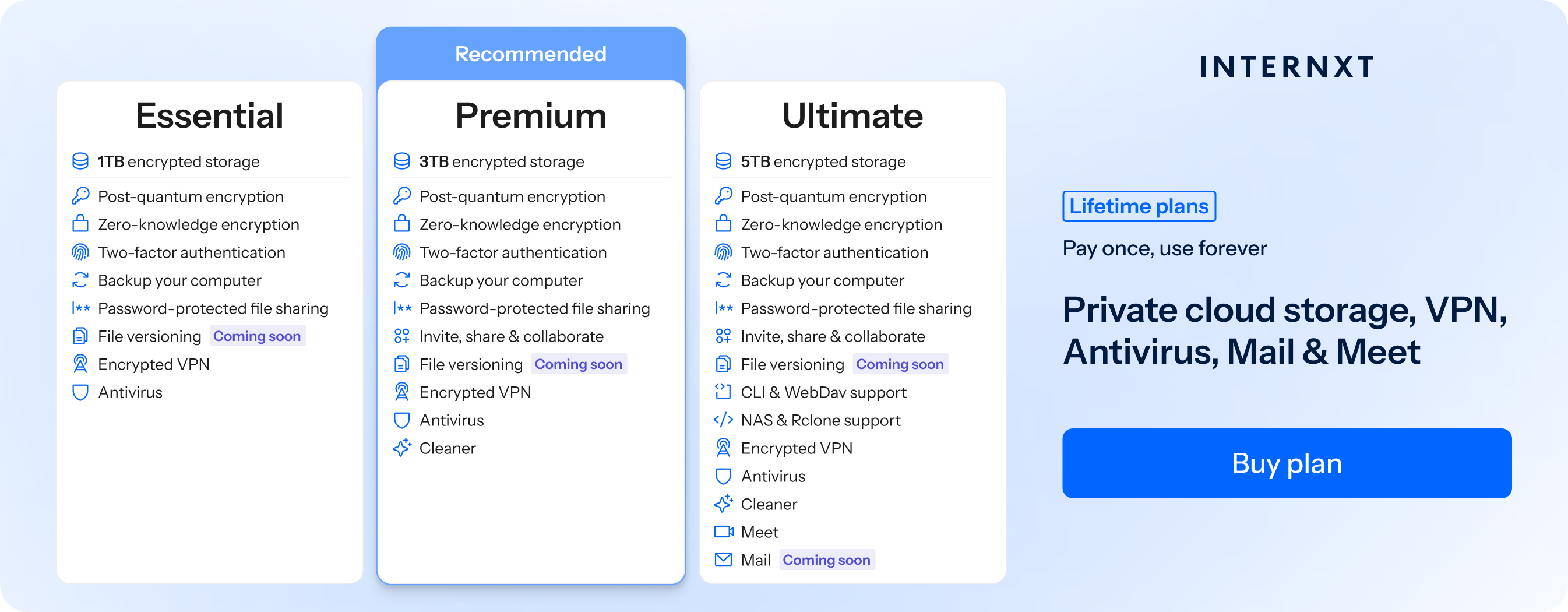
All paid plans also include cloud storage backups, so your files are protected against data loss and accessible across all devices for you to download.
Ultimate plans also include Internxt Photos for automatic backups of your photos, keeping your memories secure in the cloud and private thanks to Internxt’s zero-knowledge encryption.
With Premium and Ultimate plans, you can get extra reliability of data with file versioning, ensuring you can revert to former versions of your files in case they are accidentally changed, so you always have the up-to-date version of your data.
Internxt S3
For enterprise cloud storage solutions and data reliability, Internxt offers S3-compatible cloud object storage. It offers the same compliance standards as Internxt Drive to protect and secure data for all industries, and the following measures to ensure data reliability:
- Object Lock: Protects objects from being deleted or overwritten for a specified retention period. It helps preserve data integrity and availability, particularly for backups and important records. Depending on the implementation, it supports retention policies and legal holds.
- Durability: Data is protected from loss or corruption with technology that guarantees 99.999999999% (11 9s) of data durability and availability for each object.
- Redundancy: Data is stored and backed up in multiple data centers.
- Object versioning: Retains previous versions when objects are overwritten or deleted, making it possible to recover earlier data. Versioning must be enabled, and retention policies managed appropriately.
- Access controls and permissions: Use identity policies, bucket policies, and access restrictions to prevent unauthorized users or applications from deleting, overwriting, or improperly modifying objects.
- Immutable backups: Combine Object Lock with retention policies to protect backup copies from tampering, ransomware, and accidental deletion during the protected period.
As a European tech company, Internxt S3 offers a cheap and sovereign object storage solution to AWS, Azure, and Google Cloud. As there are no ingress of egress fees, you only pay for the storage you need, which is fully scalable and allows for petabytes of data storage at a flat fee of €7/TB/month.
To get started with cloud storage for your business, visit our website to contact one of our sales experts.
Related products
https://internxt.com/cloud-object-storage
Frequently asked questions
What is data reliability?
Data reliability is the ability to trust that information remains accurate, complete, consistent, and dependable over time.
What makes data reliable?
Reliable data is accurate, complete, consistent, up to date, and collected and maintained using dependable methods.
What is the difference between data reliability and data integrity?
Data reliability refers to how consistently data can be trusted, while data integrity focuses on maintaining its accuracy and preventing unauthorized or unintended changes.
How do you assess data reliability?
You can assess data reliability by checking for errors, missing information, inconsistencies, outdated records, and unexpected changes.
How does cloud storage ensure data reliability?
Cloud storage providers like Internxt use redundancy, integrity checks, automated repair, versioning, and backups to protect stored information.