
How Much Is A Petabyte? Local vs Cloud Storage Costs

Today, roughly 94% of enterprises are projected to use some form of cloud service, with 82% adopting hybrid models that combine cloud and on-premises infrastructure.
By 2030, around 60% of all corporate data is expected to be stored in the cloud, highlighting a major shift away from traditional storage systems toward distributed, on-demand infrastructure.
With such a huge amount of data, companies need a scalable, affordable, and secure method to store 1 PB. For this, the best option is object storage, as it allows for a platform to meet your cloud storage requirements for your enterprise.
Throughout this article, we will cover:
- How much is a petabyte of data?
- How much does a petabyte cost?
- Cloud vs local storage costs
- Best cloud storage for 1 PB and more
To understand the grand scale of 1 PB of data, we will first explain how much is a petabyte of storage compared to other storage sizes.
Table of contents
- How much is a petabyte of storage?
- Storage capacities explained
- The growth of global data storage
- How much does 1 petabyte cost?
- How much cloud storage do I need?
How much is a petabyte of storage?
1 petabyte (PB) is 1,024 terabytes (TB), or about 1,000,000 gigabytes (GB).
It is a typical cloud storage plan for large businesses or enterprises. With this amount of storage, you can store, on average:
- Photos: about 200 million to 300 million photos (assuming ~3–5 MB per photo)
- Files/documents: about **200 million to 500 million files **(assuming ~2–5 MB per file)
- HD videos (1080p): about 13,000 to 20,000 hours
- 4K videos: about 2,500 to 5,000 hours
Storage capacities explained
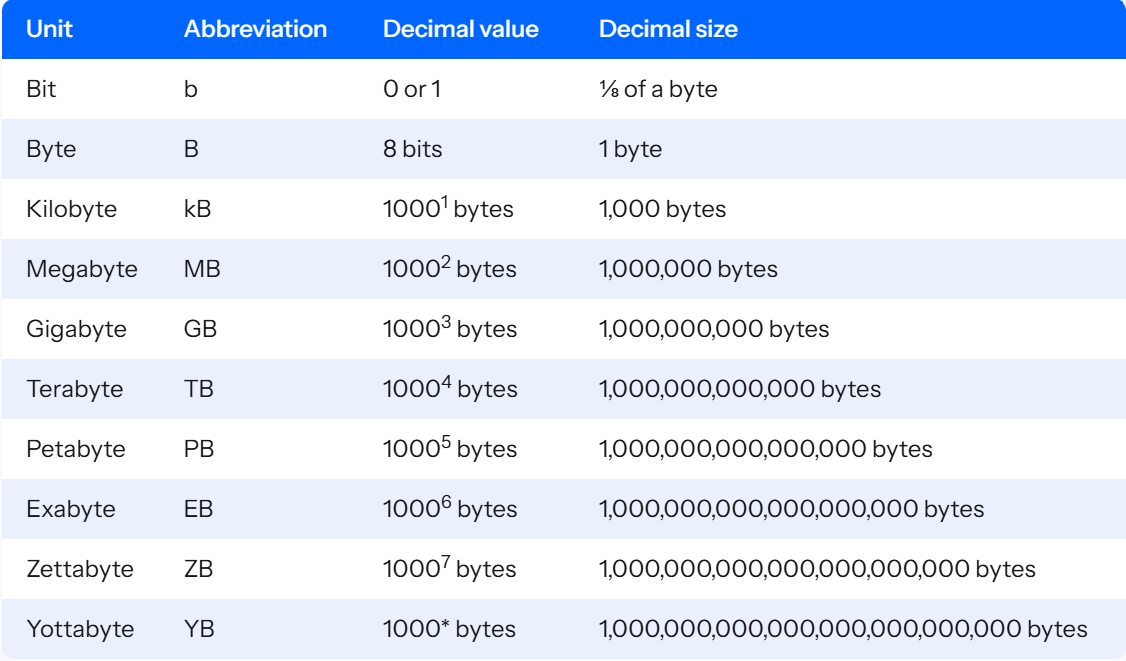
Storage capacity refers to the amount of digital information a device or system can store. For both cloud and local storage, it is typically measured in bytes, kilobytes (KB), megabytes (MB), gigabytes (GB), terabytes (TB), going all the way up to yottabytes (YB).
Each step up represents a larger amount of data, with storage needs increasing as files and applications become more complex and data-heavy.
Smaller storage capacities, such as megabytes and gigabytes, are typically found in smartphones, tablets, and everyday computers for storing apps, documents, photos, and videos.
A single photo might take a few megabytes, so for this, free cloud storage options would be enough. On the other hand, a high-definition movie can take up several gigabytes, so you would likely need between 1 and 3 TB of storage to store these files.
Larger capacities, such as terabytes and petabytes, are used in external hard drives, servers, and data centers.
These systems store massive amounts of information, including databases, cloud backups, and entire media libraries. As a result, businesses may choose cloud migration strategies to transfer these large data sets to the cloud, as it is more affordable, secure, and scalable.
For a more detailed view of storage conversions, check out our free byte converter tool on our website below.
Choosing the right capacity depends on usage needs, such as casual personal use, professional media work, or enterprise-level data management, which we will cover next.
The growth of global data storage
By 2030, global data storage is projected to reach approximately 500–600 zettabytes, or approximately 500 - 600 million petabytes of data.
This reflects a continuation of exponential growth driven by AI systems, cloud computing, video streaming, IoT devices, and enterprises migrating to the cloud.
By 2030, data storage will no longer be measured in tens or hundreds of petabytes at scale, but in hundreds of millions of petabytes globally, requiring massive distributed storage systems across hyperscale cloud infrastructures.
As a result, larger businesses considering moving to the cloud may wonder how much does 1 petabyte cost, and is it worth investing in the cloud, which we will answer below.
How much does 1 petabyte cost?
Local storage
Now that we know how much is a petabyte of storage, we will consider the following regarding 1 petabyte only for local storage and the average costs associated with it.
Regarding the storage requirements, these are the typical scenarios when storing such a large amount of data:
- Data will be retained for five years under a typical storage contract.
- Data will be in an unstructured format, stored in object storage.
- Data is used for secondary purposes like backups, media, web content, and user-generated content, with infrequent access needs.
Here is the full breakdown, including the assumptions, formatted clearly and consistently:
- System hardware: $500,000, includes enterprise storage arrays, redundancy (RAID/replication), controllers, and spare capacity required for 1 PB OF usable storage.
- Maintenance: $375,000 15% plus annual maintenance costs which cover vendor support, replacements, firmware updates, and service level agreements.
- Facilities (space, power, cooling): $60,000, 1 PB requires approximately 25%–50% of a standard 42U rack. Power and cooling are estimated at $1,200 per square foot per year, using ~10 square feet (~$12,000 per year).
- Admin support (0.5 FTE): $375,000, a full-time IT/storage administrator at $150,000 annual salary over 5 years, covering monitoring, backups, security, maintenance coordination, and incident response.
Total 5-year cost: $1,310,000
Object storage
Estimated 1 PB storage cost of Internxt S3 per month
- €7,168 per month
Average costs for AWS Standard Storage
- €21,000–€23,000 (depending on region and pricing).
Internxt network fees (e.g., ingress & egress costs)
- €0
AWS network fees
- Ingress: €0
- Egress (1 PB fully downloaded in a month): about €80,000–€90,000 per month
Internxt data access fees (API calls/operations)
€0
AWS data access fees
- €1,000–€5,000 per month
Internxt 1 PB storage cost per month:
- €7,168
AWS:
- €102,000–€118,000
How much cloud storage do I need?
Personal, business, and enterprise storage all have different needs, which we will cover in more detail below, but below you can find a general overview.
| Category | Typical Storage Needs | Description | Storage Type |
|---|---|---|---|
| Personal Use | 128 GB – 1 TB | Apps, photos, videos, documents, everyday use. Higher needs for gaming or editing. | Local: fast, offline, limited capacity. Cloud: accessible anywhere, scalable, internet required. |
| Business Use | Several TB – Tens of TB | Emails, customer data, backups, financial records, shared files. | Local: fast internal access. Cloud: flexible scaling and remote access. |
| Enterprise Use | Hundreds of TB – PB scale | Large-scale systems, analytics, infrastructure, massive data processing. | Local: high-performance internal systems. Cloud: massive scalability and redundancy. |
Cloud storage for personal use
For personal cloud storage, requirements are usually moderate. Most users can manage well with free cloud storage plans, or paid plans offering from 200 GB to 1 TB of storage.
This is generally enough for apps, documents, photos, videos, and everyday use. People who mainly stream content or store files in the cloud can operate with lower local storage, while users who work with large media files, such as high-resolution video or photography, may need additional external storage.
If you have bigger storage needs, you may need to consider the different cloud storage or physical storage devices available.
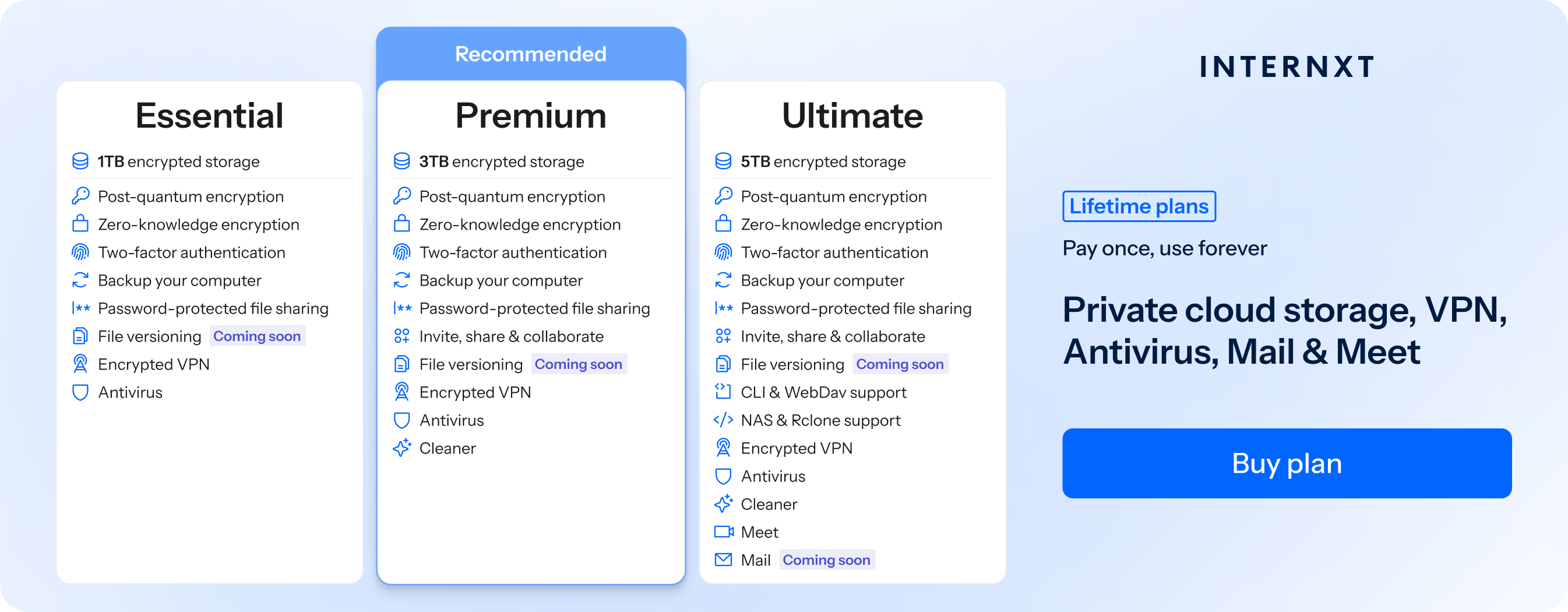
Internxt Drive plans offer up to 5TB of cloud storage, and a full privacy suite of products including Meet, Mail, VPN, and more. You can also connect your Drive account to your NAS system or connect via native rclone support.
If you want cloud storage only, Internxt also offers up to 100TB with plans bought from Stacksocial.
Cloud storage for business and families
For small to medium-sized businesses, families, or teams, it may often require several terabytes of storage shared between users to handle documents, customer records, emails, financial data, and backups.
For these purposes, you can choose from Internxt Business plans or Internxt Family plans.
For enterprises
Enterprise-level storage is far more extensive, often ranging from hundreds of terabytes to petabytes. For this, object storage is the best use case, as it allows for storage and cloud backups of large amounts of data with low latency, meaning data can be accessed instantly.
Large organizations such as tech companies, financial institutions, and research facilities manage vast amounts of data, including user information, analytics, and large-scale digital services.
These environments require highly scalable and secure systems capable of handling constant data growth and high demand.
For petabytes of storage, Internxt offers 100% hot cloud storage for enterprises at a fixed cost of €7 / TB / month, with no extra data transfer fees, making it a cheaper option than AWS, Azure, or Google Cloud
So if you’re wondering how much 1 petabyte of cloud storage vs local costs with Internxt S3, it would be:
Internxt S3 1 petabyte storage cost: Total cost for 1 PB with Internxt S3 would cost €7,168 per month, no extra maintenance or data transfer costs
Local storage 1 petabyte storage cost: Roughly €15,000 to €30,000 upfront, depending on the hardware and setup, plus €1,000 to €3,000 for additional costs such as electricity, cooling, maintenance, drive replacements, or adding additional storage.
1 petabyte storage cost savings: About 24% to 48% savings when choosing Internxt S3 for 1 petabyte of storage compared to local storage.
S3 storage plans offer multiple compliance, offering the best security and data handling for multiple industries.
To contact our sales team about setting up our object storage plans, you can visit our website.
You can also benefit from our cloud storage reseller program and become an Internxt partner, which you can learn more about by visiting the page below.